Knowledge

The Application of Solidot's CC-Link Remote I/O in TV Production Line
With the arrival of curved TVs and 8K TVs, our smart home life has become more convenient and dreamlike. Whether it is a spectacular concert or an exciting goal moment, every scene and shot is vivid and rendered in the finest detail. So how does 8K achieve such an immersive, on-site experience?
8K is 7680 x 4320 pixels, which is 4 times the resolution of a 4K display and 16 times that of 2K. On a screen of the same size, the more pixels there are, the finer the image is rendered. This also means that 8K ultra HD can restore the real image to a great extent, achieving an effect extremely close to what the human eye sees.
remote I/O Application in a Smart TV Production line
The smart production line for 8K TVs is completed by a large number of "robot + vision" systems, with a very high degree of intelligence. In this case, the PLC is a Mitsubishi Electric Q series, the master module is a Mitsubishi Electric QJ61BT11N, and the remote I/O uses modules from both Solidot and Mitsubishi that support the CC-Link protocol. The Solidot modules are mainly responsible for acquiring and controlling the pushbutton signals and Indicator signals of the operator boxes on the conveyor line, as well as the interaction signals with the robot stand-alone equipment, safety signals, and control cabinet control signals, while the I/O signals of the photoelectric sensors on the belt line and the run signals of the frequency converters are acquired through the Mitsubishi Electric modules. This setup is mainly intended by the customer to unify the Mitsubishi Electric remote I/O and frequency converters for easier subsequent maintenance.
In addition to the "seamless integration" demonstrated by the Solidot CC-Link protocol remote I/O modules in this case, they can also achieve perfect replacement in some other solutions, making them stable, highly competitive premium domestic substitutes.
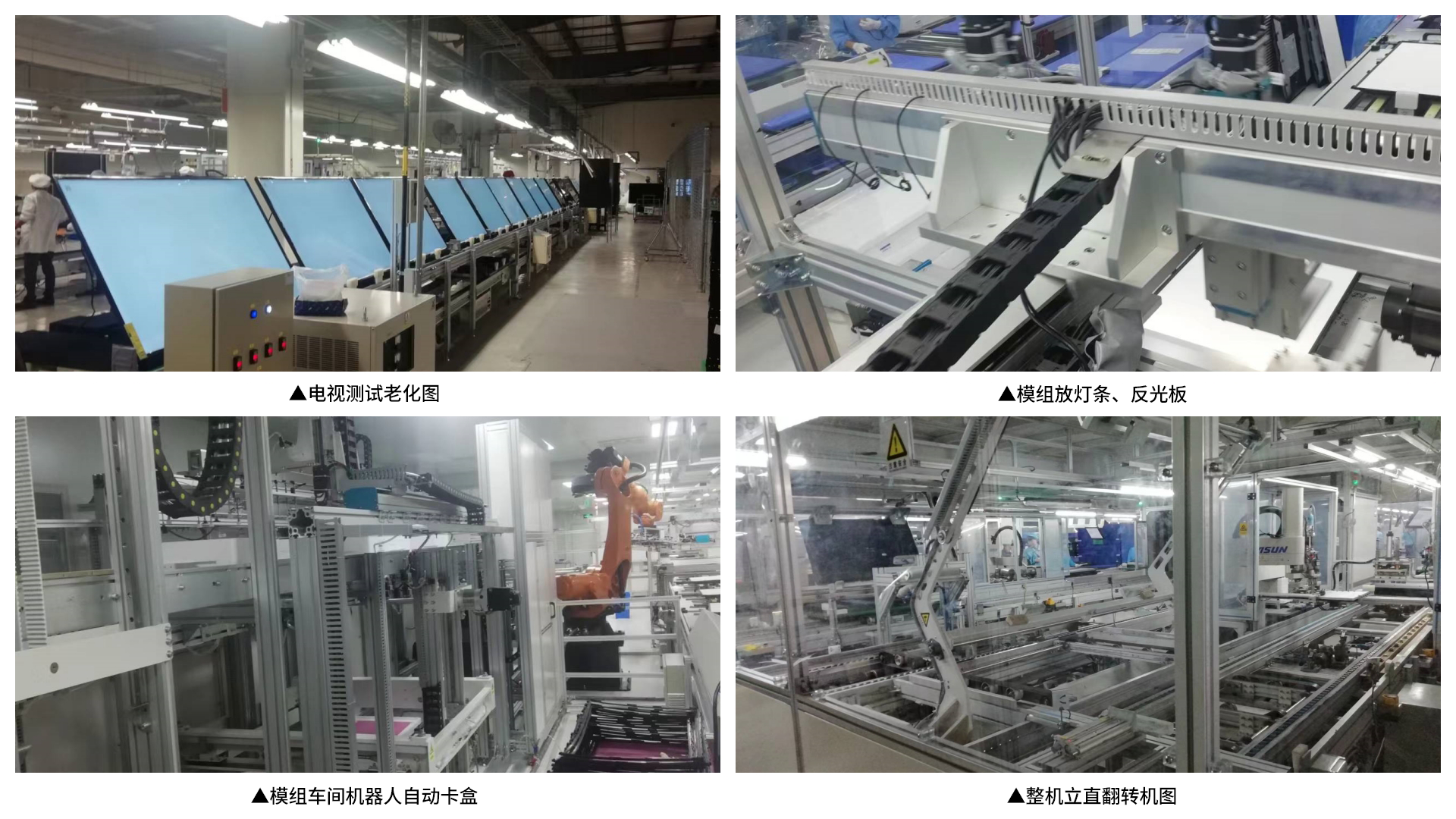
Equipment and process description of the 8K TV Smart Production line
Common production line zones:
(1) module zone: automatic Backplane loading equipment, dispensing equipment, robot vision AI cassette equipment, TV glass and film sorting and depalletizing equipment
8K TV Production process Flow
First, the stamped TV Backplane is transported by the conveyor line to the module workshop. In the module workshop, adhesive is applied by the dispensing equipment, then the light bars are installed manually, the light bar wiring is installed, the wiring is tidied up, and the light guide plate is installed. Then it is transported by the conveyor line to the robot cassette area for vision photographing. The robot picks up the TV LCD glass after the film has been peeled off by the film peeling machine, receives the position sent by the vision system, and then places it into the cassette onto the Backplane.
Next, the TV semi-finished product completed in the module zone is transported by the conveyor line to the final assembly zone. After being flipped by a 180-degree flipping machine, the mainboard, power supply board and other TV accessories are installed, and then it reaches the robotic screwdriver station for screw fastening. The final assembly workshop then completes the entire assembly of the TV.
After being flipped by a 90-degree flipping machine, the TV is transported by the upper lift to the aging workshop for power-on testing, high-voltage testing, white balance testing, Logo vision and factory inspection, and manual inspection. Finally, the TV is laid flat and powered off, and transported by the lower lift to the packaging zone.
On arriving at the packaging zone, a transverse transfer manipulator picks up the TV and places it onto the bagging equipment. After the TV is bagged, it is flipped and packed into a carton together with accessories such as the TV remote control. After this is completed, it is weighed and the carton is sealed and the bottom folded. The labeling machine applies a label to the TV carton, and finally the strapping is done. After material handling by the carton merging machine, it is transported to the storage zone.
On arriving at the storage zone, the products are sorted by code reading with a code reader. Products of the same batch and model are palletized by the palletizer, then transported to the film wrapping machine for film wrapping. After that, the entire pallet is labeled and transported by AGV to the automated warehouse for inbound storage.
Application method of the Solidot CC4-1616A in the Distribution Cabinet
The control systems of these devices all use Mitsubishi Electric Q series PLCs, and the stand-alone equipment uses Mitsubishi Electric FX5U series PLCs. Because the entire smart 8K TV production line is relatively long, the CC-Link protocol is used throughout to connect the entire network. In addition, the CC-Link network allows "Y-shaped" and serial connection routing, so it combines both flexibility and convenience. In the actual on-site environment, the junction boxes and pushbutton boxes have little space, and using the Solidot CC4-1616A solves this pain point exactly: the integrated design offers an obvious advantage in its small size, and wiring is also very convenient.
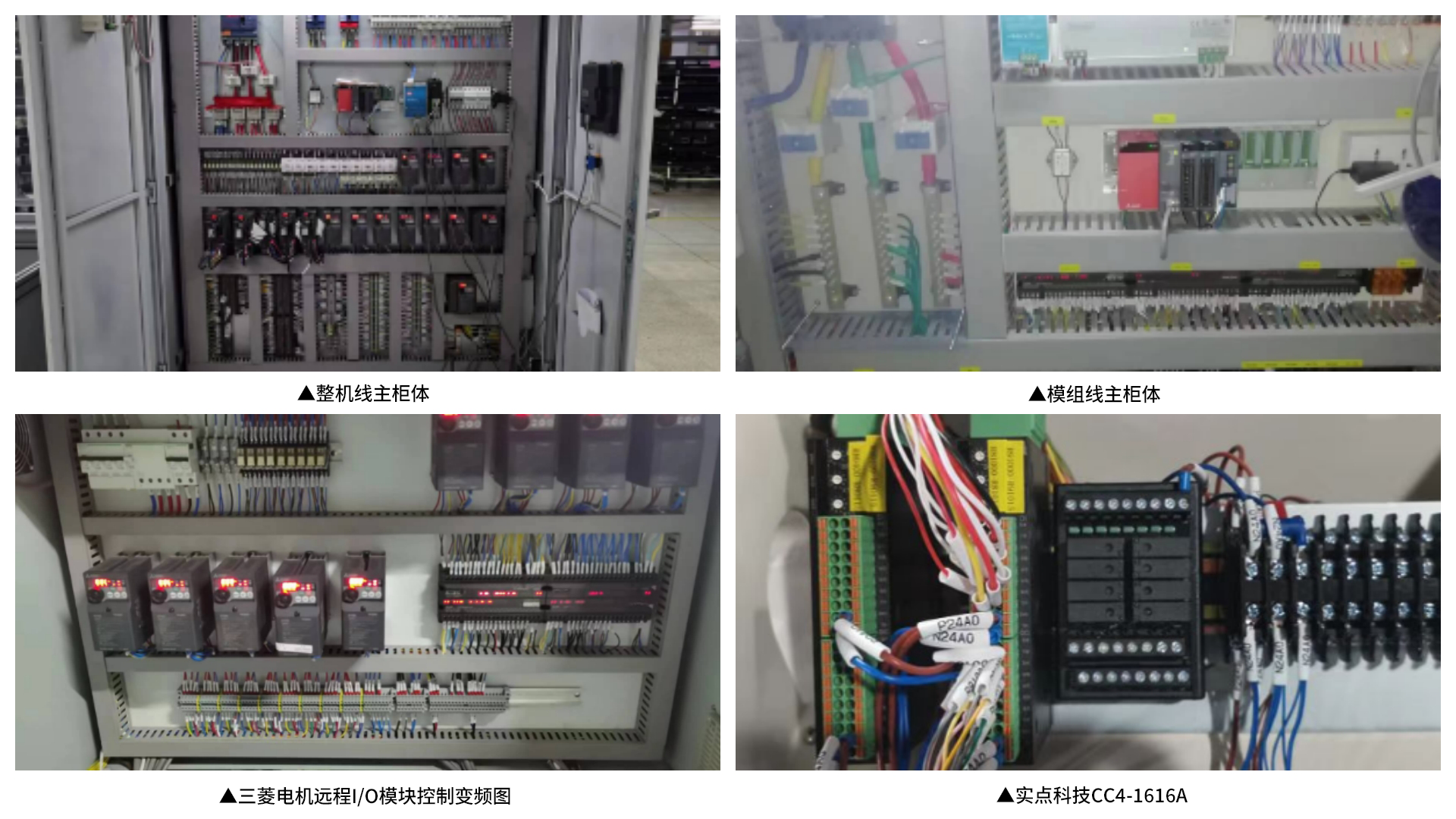
As can be seen from the figure above: every station on the line has a pushbutton box, and the input signals of the pushbuttons and the Indicator signals are acquired by CC4-1616A modules installed close to the equipment; in addition, the interaction signals with the robot stations are also acquired through the CC4-1616A. The robot control cabinet has only a small space available for installation, and its compact size is the best solution.
Solidot remote I/O PLC Program diagram
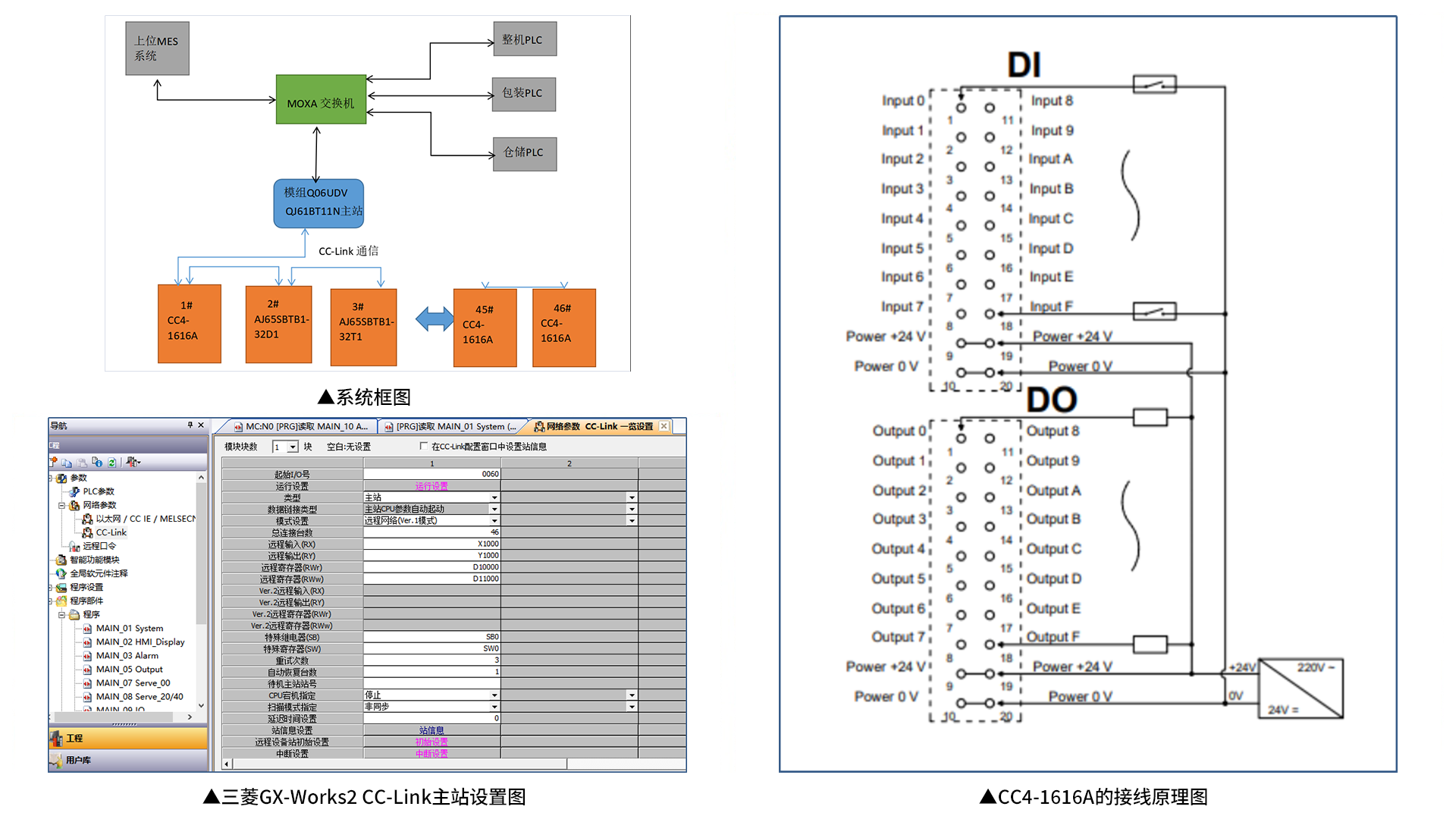
The Solidot CC4-1616A serves as a remote I/O Station under the Mitsubishi QJ61BT11N master, occupying 1 station, 32 inputs and 32 outputs. Because the on-site line is relatively long, the baud rate used is 1. The figure below shows the remote I/O settings in the GX-Works2 software:
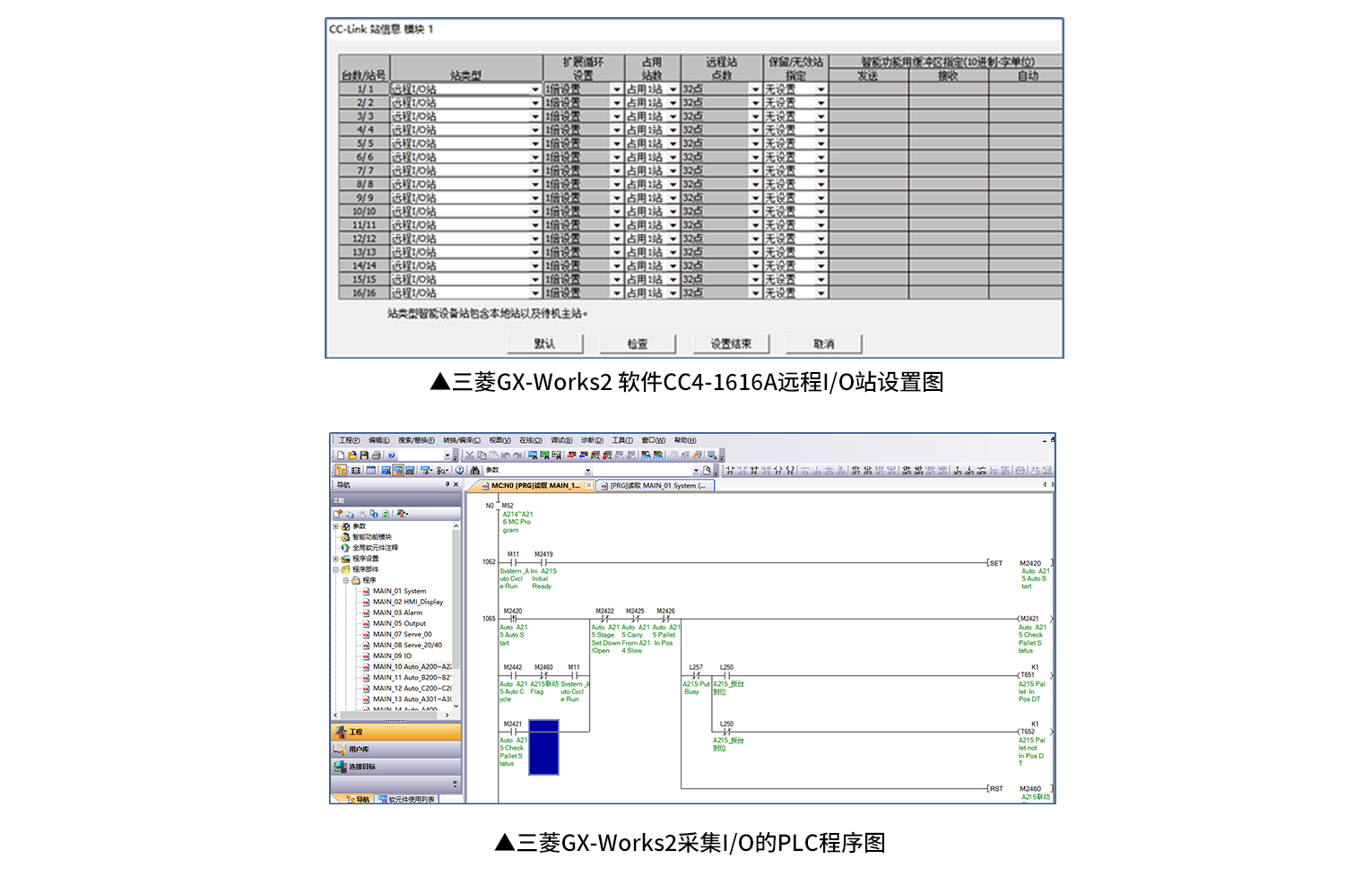
Solidot CC4-1616A product Introduction
In this case, the overall wiring is simple and flexible. Both "Y" and daisy-chain topologies are supported, and the wiring length can reach up to 1200 meters. Combined with the inherent product advantages of the Solidot integrated I/O module CC4-1616A — its compact size and high point count — it can be said to achieve perfect integration when mixed with Mitsubishi Electric remote I/O, making replacement and maintenance very convenient.
Recommended Products

More
Solidot XB6 Series PROFINET Slice I/O Module in the non-standard automation industry
The application of Solidot's remote Slice I/O module XB6S in the automotive manufacturing stamping station
Solidot's Simplified Wiring Distributed I/O XBF Application in Lithium Battery Module Pack Lines
Application of Solidot PN5R Series All-in-One I/O Module in Liquid Filling Production Line
Application of Solidot IO-Link Bus I/O in Lithium Battery Wrapping Test Machine











3553359594
Address
Building 40, No. 9-1 Yinlong Road, Nanjing