Knowledge

Solidot has maintained a long-term, close cooperative relationship with Mitsubishi Electric. Since its founding, the company has established strong ties with the CLPA organization, accumulating deep expertise over the years in products based on CC-Link, CC-Link IE Field Basic, and CC-Link IE TSN protocols.
Engine industry background
In recent years, the domestic automotive industry has flourished. Hybrid and new energy vehicles are the mainstream models promoted by the automotive industry, and the state has introduced multiple supportive policies. Beyond purchase subsidies for new energy vehicles, license plate policies have also been adjusted accordingly, using bright green plates to promote new energy and environmental concepts.
The emergence of new energy vehicles has driven the upgrade and renewal of multiple industrial chains in the automotive sector. As is widely known, the engine is the power source of a vehicle, and the crankshaft, as the most critical component of the engine, is in short supply in the market. In response to government policies, crankshaft manufacturers have undertaken new upgrades and renovations of their workshops. Factory floors have been integrated with MES systems, and the machine tools on every production line are connected to the internet. This initiative has brought comprehensive advancement to manufacturing equipment, processes, and core technologies on the production line, driving and realizing intelligent manufacturing. It has both improved production efficiency and reduced costs, bringing the entire crankshaft production line to an optimal state.
Application of CB4 series integrated I/O modules in automatic loading/unloading of engine crankshafts
Engine crankshafts range in weight from 20 kg to 200 kg. Previously, each process step relied on manual labor and cranes for material transfer. The introduction of KUKA and FANUC robots has significantly reduced manual labor. The forged crankshafts pass sequentially through machine tools for loading/unloading logistics, finish milling, finish centering, straight oil holes, angled oil holes, semi-finish grinding of connecting rod journals, semi-finish grinding of main journals, finish grinding of main journals, finish grinding of connecting rod journals, drilling the large end, drilling the small end, inspection station, transfer station, polishing machine, and deburring. In each cell, the robot control cabinet is an FX5U, and the FANUC robot performs machine loading/unloading. One cell has a loading logistics FX5U and an unloading logistics FX5U.
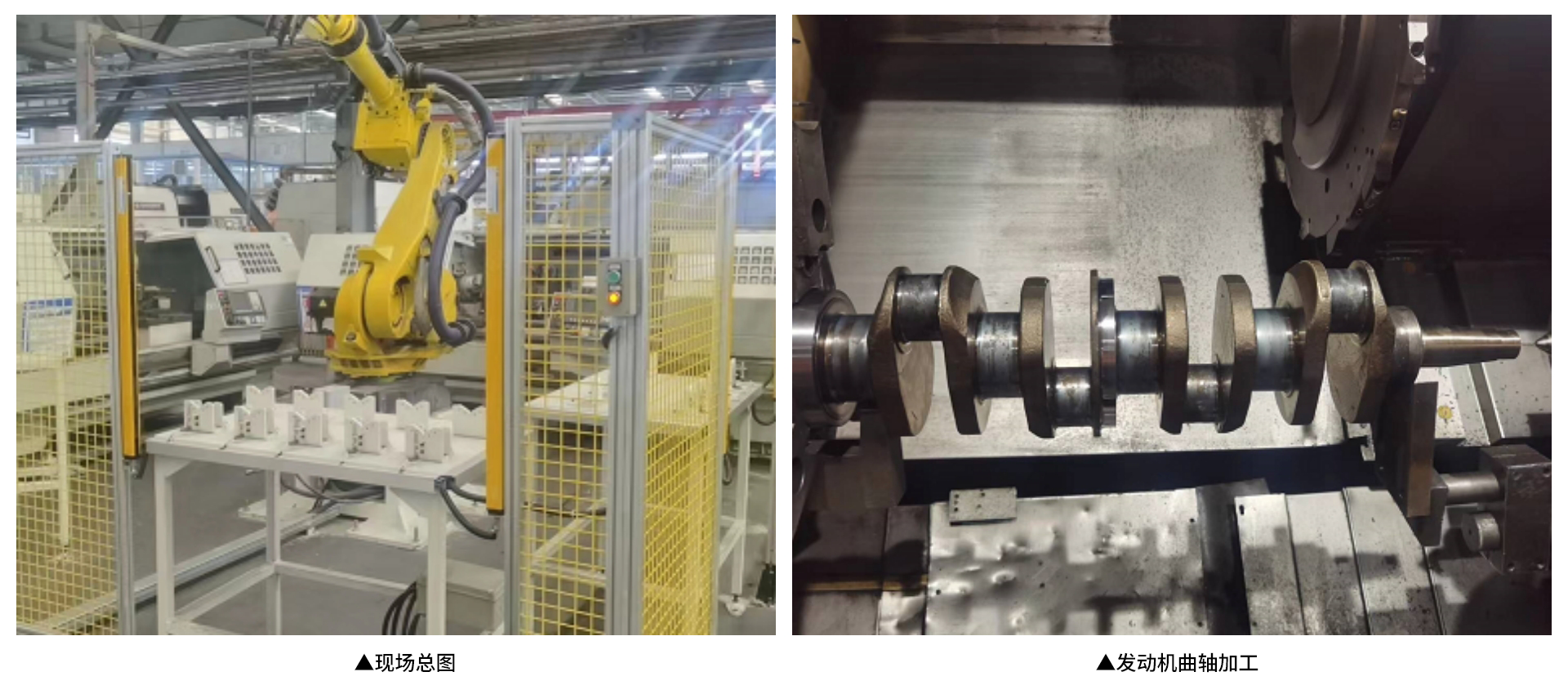
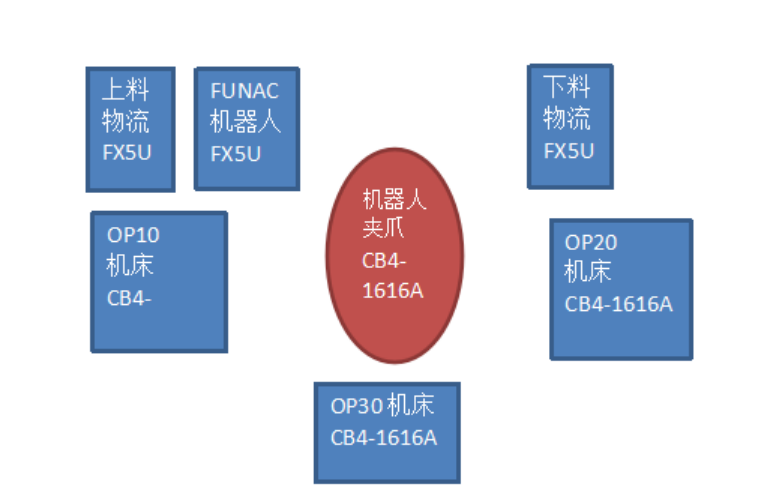
▲ FANUC action flow diagram
The FANUC robot gripper has an A-jaw and a B-jaw. The detection input points (clamp position, release position, material presence detection) and output points (Solenoid valve gripper open and gripper clamp) of the A and B jaws are handled through a CB4-1616A, with 16 inputs and 16 outputs.
1. Loading logistics:
The FANUC robot moves to the loading logistics station to pick up unmachined crankshafts (the loading logistics PLC FX5U communicates with the FANUC robot's FX5U).
2. 1# machine tool OP10:
The crankshaft picked up by the robot from the loading logistics station is processed at the 1# machine tool. The robot first uses the B-jaw to pick up material, then uses the A-jaw to place the material. The machine's emergency stop, online status, loading request, unloading request, loading complete, unloading complete, and robot entry into the machine area are implemented through the remote CB4-1616A.
3. 2# machine tool OP20:
Robots grab shafts from machine 1# and process them at machine 2#, where gripper A first picks up the workpiece and gripper B then unloads it. The machine's emergency stop, linkage, load request, unload request, load complete, unload complete, and robot entry into the machine area are implemented through the remote CB4-1616A.
4. OP30 at machine 3#:
Robots grab shafts from machine 2# and process them at machine 3#, where gripper B first picks up the workpiece and gripper A then unloads it. The machine's emergency stop, linkage, load request, unload request, load complete, unload complete, and robot entry into the machine area are implemented through the remote CB4-1616A.
5. Unloading logistics:
The robot moves to the unloading logistics station and places the finished crankshaft on the unloading line, completing the entire production process (the loading logistics PLC FX5U communicates with the FX5U of the FANUC robot).
Solidot I/O PLC Program configuration diagram
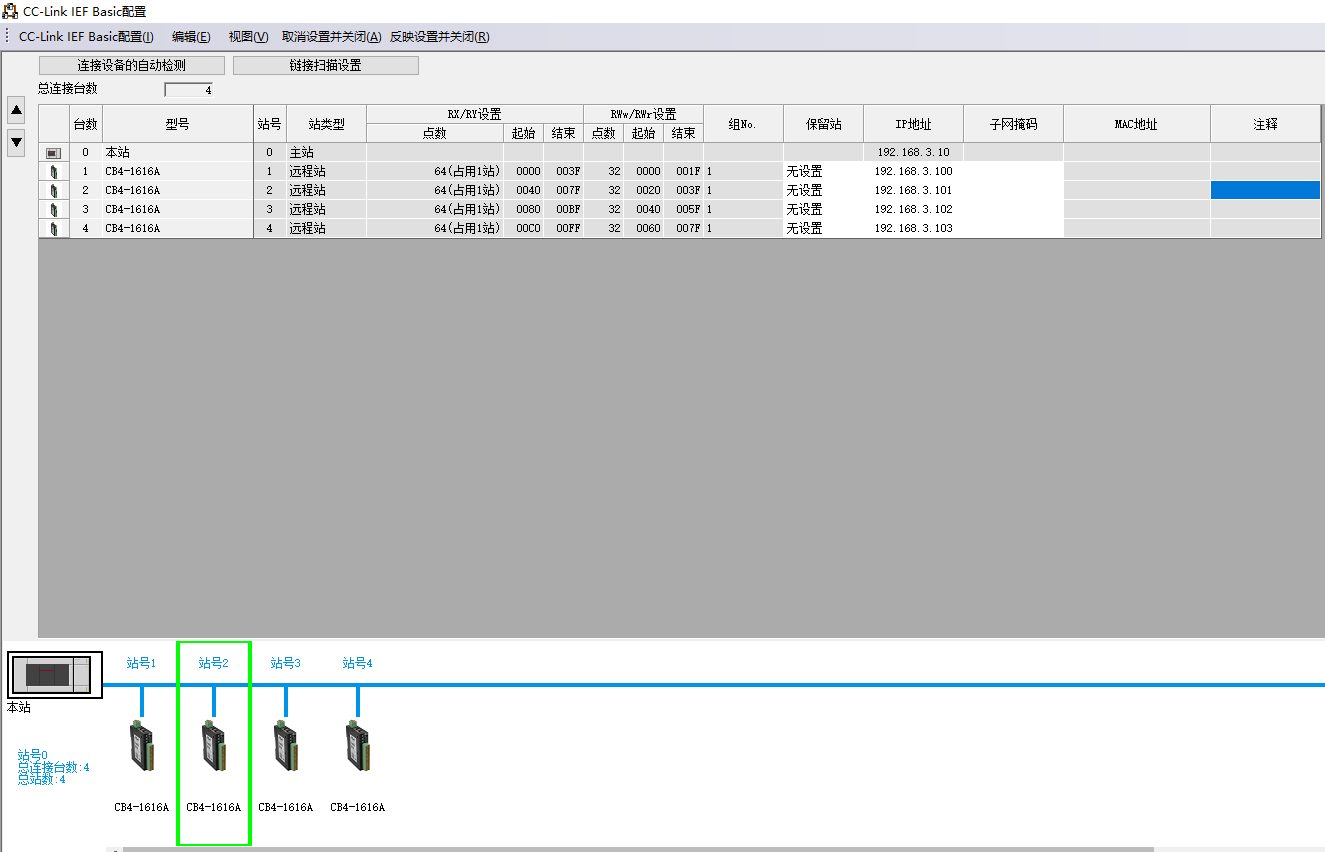
▲ CC-Link IE Field Basic
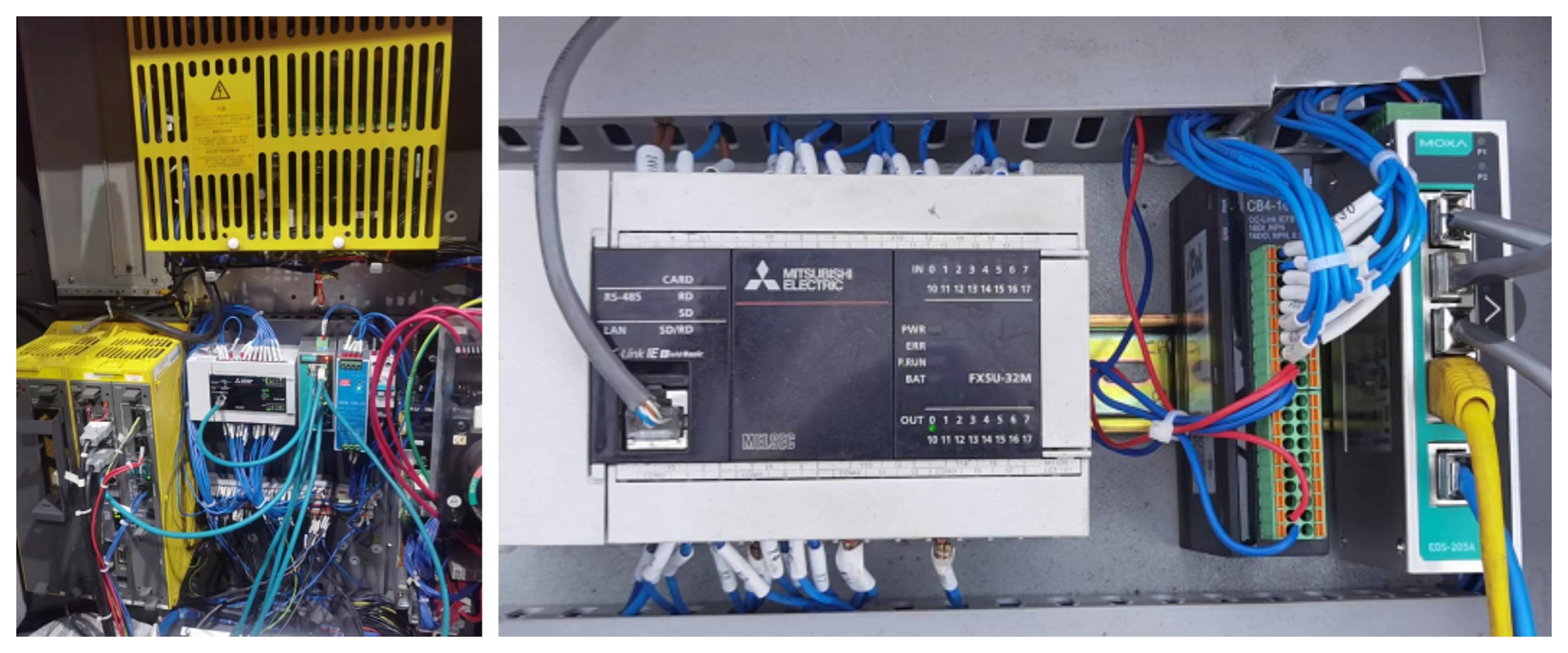
▲ power Distribution Cabinet diagram
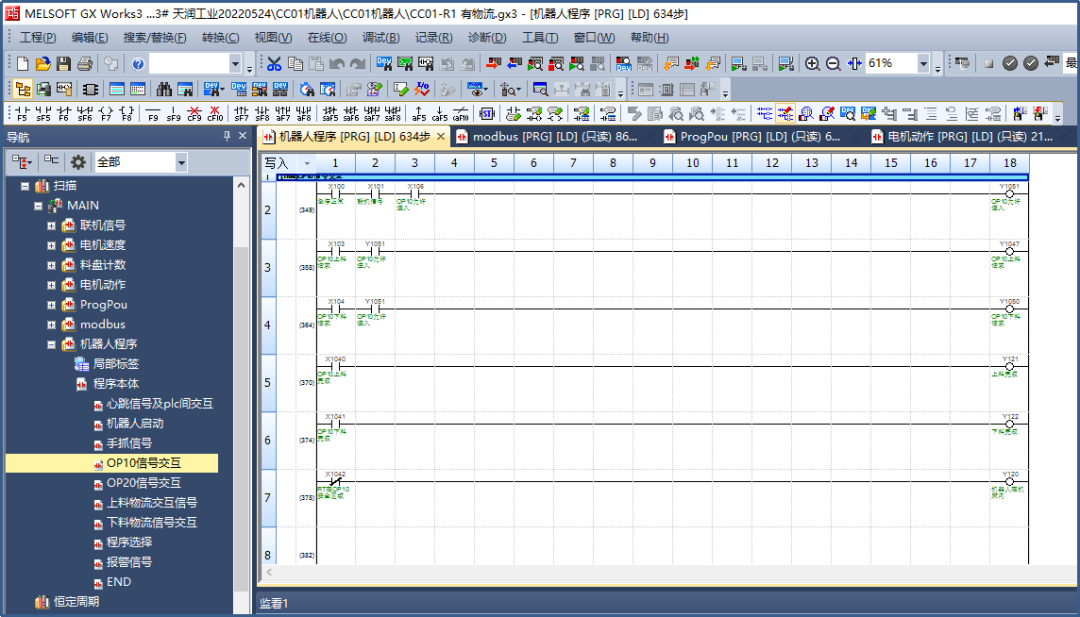
▲ Solidot remote I/O PLC Program control
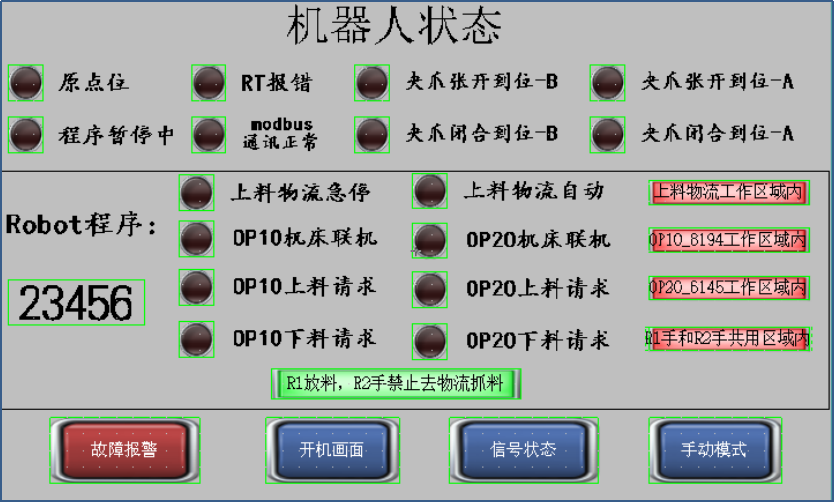
▲ Solidot remote I/O signal HMI monitoring control
Advantages of Using the CC-Link IE Field Basic device-level network
(1) Networks can be built with a smaller configuration
(2) Simple startup and simple troubleshooting
(3) Coexists with TCP/IP communication
(4) Continuously expanding range of connectable products
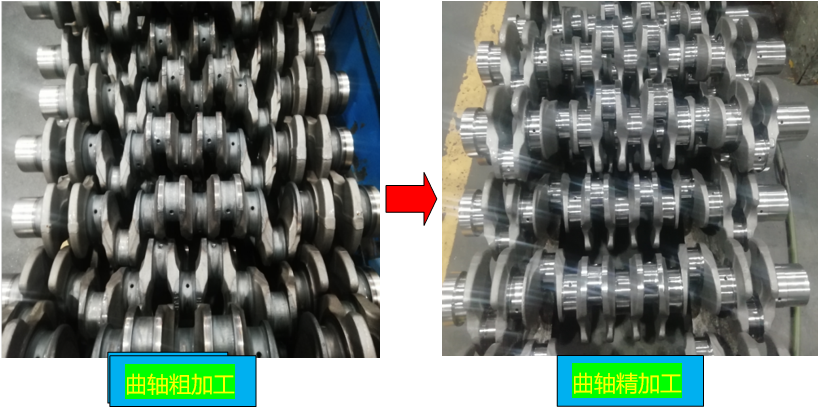
▲ Evolution from crankshaft rough machining to crankshaft finish machining
CB4-1616A product Introduction
Solidot is a well-known domestic I/O manufacturer. The CB4-1616A supports the CC-Link IE Field Basic network and offers 16 inputs and 16 outputs.
The I/O in the field is quite distributed, including I/O acquisition for the robots and handshake signals from the machines, with the machines on site being separate and independent. The CB4-1616A is an integrated I/O module that requires only one network cable and one set of power cables for both power supply and communication, making installation and wiring very convenient and quick.
The CB4-1616A is an integrated I/O module with both inputs and outputs. It takes up very little space, is easy to install in cabinets, and is cost-effective.
▲ FANUC action flow diagram
The FANUC robot gripper has an A-jaw and a B-jaw. The detection input points (clamp position, release position, material presence detection) and output points (Solenoid valve gripper open and gripper clamp) of the A and B jaws are handled through a CB4-1616A, with 16 inputs and 16 outputs.
1. Loading logistics:
The FANUC robot moves to the loading logistics station to pick up unmachined crankshafts (the loading logistics PLC FX5U communicates with the FANUC robot's FX5U).
2. 1# machine tool OP10:
The crankshaft picked up by the robot from the loading logistics station is processed at the 1# machine tool. The robot first uses the B-jaw to pick up material, then uses the A-jaw to place the material. The machine's emergency stop, online status, loading request, unloading request, loading complete, unloading complete, and robot entry into the machine area are implemented through the remote CB4-1616A.
3. 2# machine tool OP20:
Robots grab shafts from machine 1# and process them at machine 2#, where gripper A first picks up the workpiece and gripper B then unloads it. The machine's emergency stop, linkage, load request, unload request, load complete, unload complete, and robot entry into the machine area are implemented through the remote CB4-1616A.
4. OP30 at machine 3#:
Robots grab shafts from machine 2# and process them at machine 3#, where gripper B first picks up the workpiece and gripper A then unloads it. The machine's emergency stop, linkage, load request, unload request, load complete, unload complete, and robot entry into the machine area are implemented through the remote CB4-1616A.
5. Unloading logistics:
The robot moves to the unloading logistics station and places the finished crankshaft on the unloading line, completing the entire production process (the loading logistics PLC FX5U communicates with the FX5U of the FANUC robot).
Solidot I/O PLC Program configuration diagram
▲ CC-Link IE Field Basic
▲ power Distribution Cabinet diagram
▲ Solidot remote I/O PLC Program control
▲ Solidot remote I/O signal HMI monitoring control
Advantages of Using the CC-Link IE Field Basic device-level network
(1) Networks can be built with a smaller configuration
(2) Simple startup and simple troubleshooting
(3) Coexists with TCP/IP communication
(4) Continuously expanding range of connectable products
▲ Evolution from crankshaft rough machining to crankshaft finish machining
CB4-1616A product Introduction
Solidot is a well-known domestic I/O manufacturer. The CB4-1616A supports the CC-Link IE Field Basic network and offers 16 inputs and 16 outputs.
The I/O in the field is quite distributed, including I/O acquisition for the robots and handshake signals from the machines, with the machines on site being separate and independent. The CB4-1616A is an integrated I/O module that requires only one network cable and one set of power cables for both power supply and communication, making installation and wiring very convenient and quick.
The CB4-1616A is an integrated I/O module with both inputs and outputs. It takes up very little space, is easy to install in cabinets, and is cost-effective.