Knowledge

In recent years, China's food and beverage industries have maintained steady growth, the variety of liquid food products has continued to expand, and demand for the construction and upgrading of filling and packaging lines has kept growing. A liquid filling line is typically dozens of meters long, with many stations and a fast cycle rate, placing high demands on the flexibility and response speed of the control system. As the concept of distributed deployment gains popularity, remote I/O modules that are installed nearby and expanded on demand are becoming the mainstream choice for automation control in liquid filling production lines. This case study takes a liquid filling production line as its subject and examines the practical application of Solidot PN5R Series integrated I/O modules.
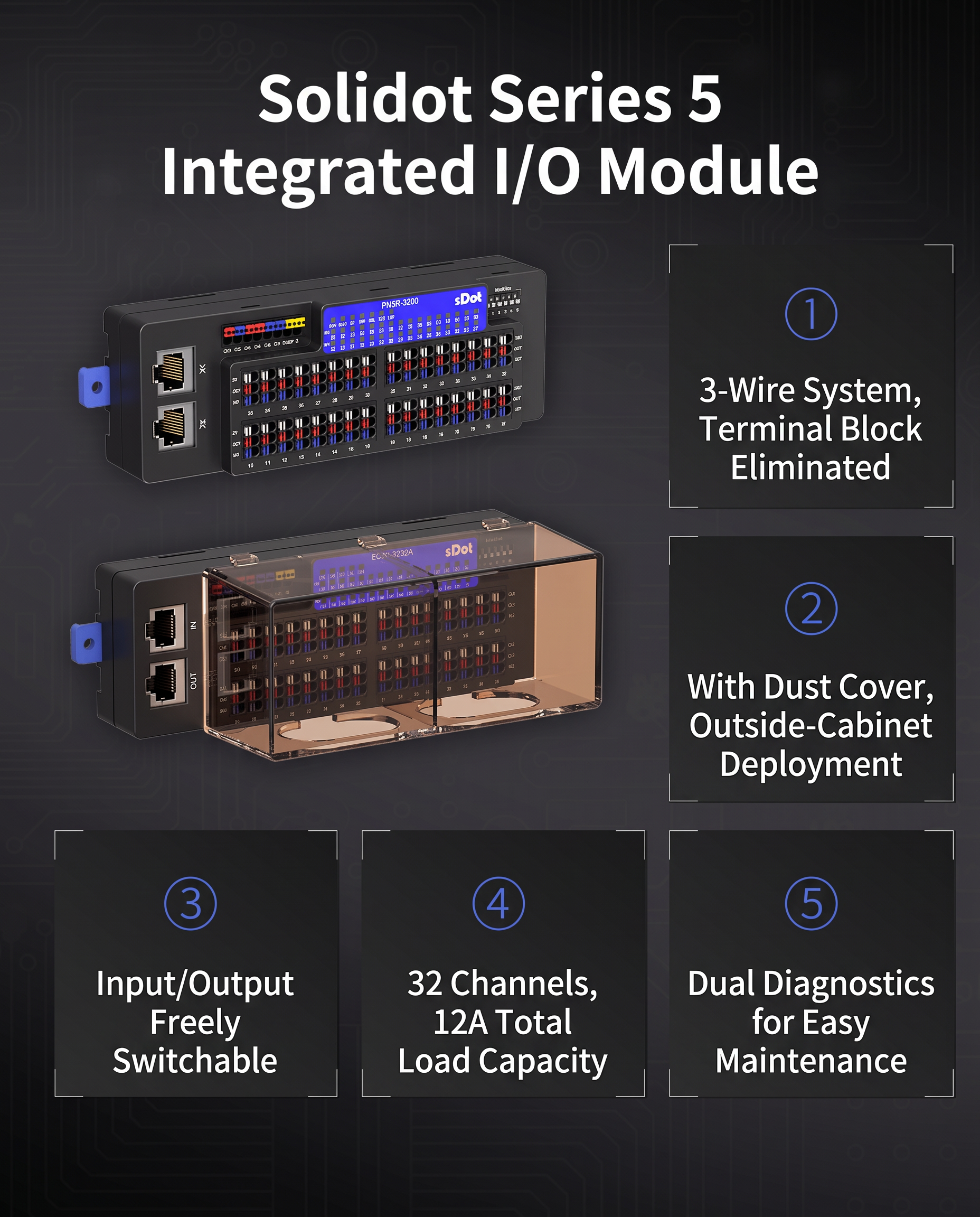
Solidot products used in this case study: PN5R Series integrated I/O modules
1. Equipment overview
A liquid filling production line is a core part of automated production in the food and beverage industry and is widely used in the packaging of liquid products such as beverages, condiments, edible oil and dairy products. Such a line usually consists of an empty bottle (empty can) infeed unit, a bottle washing/sterilization unit, a metering filling unit, a capping/sealing unit, a labeling unit, an inline inspection unit and a case packing and palletizing unit, and can complete the entire process from container supply and filling metering through sealing and packaging to finished-product inspection.
The overall line process covers the following typical stations:
Process step | Action description |
① Empty bottle infeed | Empty bottles are automatically conveyed to the filling station by conveyor belt, where the bottles are positioned and clamped |
② Bottle washing/sterilization | The interior of the containers is cleaned and sterilized to ensure that hygiene conditions meet the standard before filling |
③ Metering filling | Piston-type or pressure-type filling valves are used to inject a metered quantity of liquid into the containers |
④ Capping/sealing | Caps are automatically sorted and placed, and screw capping or press capping is performed to achieve a seal |
⑤ Inline inspection | Inline inspection of the fill level, cap torque, label position and visual defects |
⑥ Case packing and palletizing | Rejected products are automatically removed based on the inspection results, and conforming products are fed to the palletizer |
II. Solidot Solution
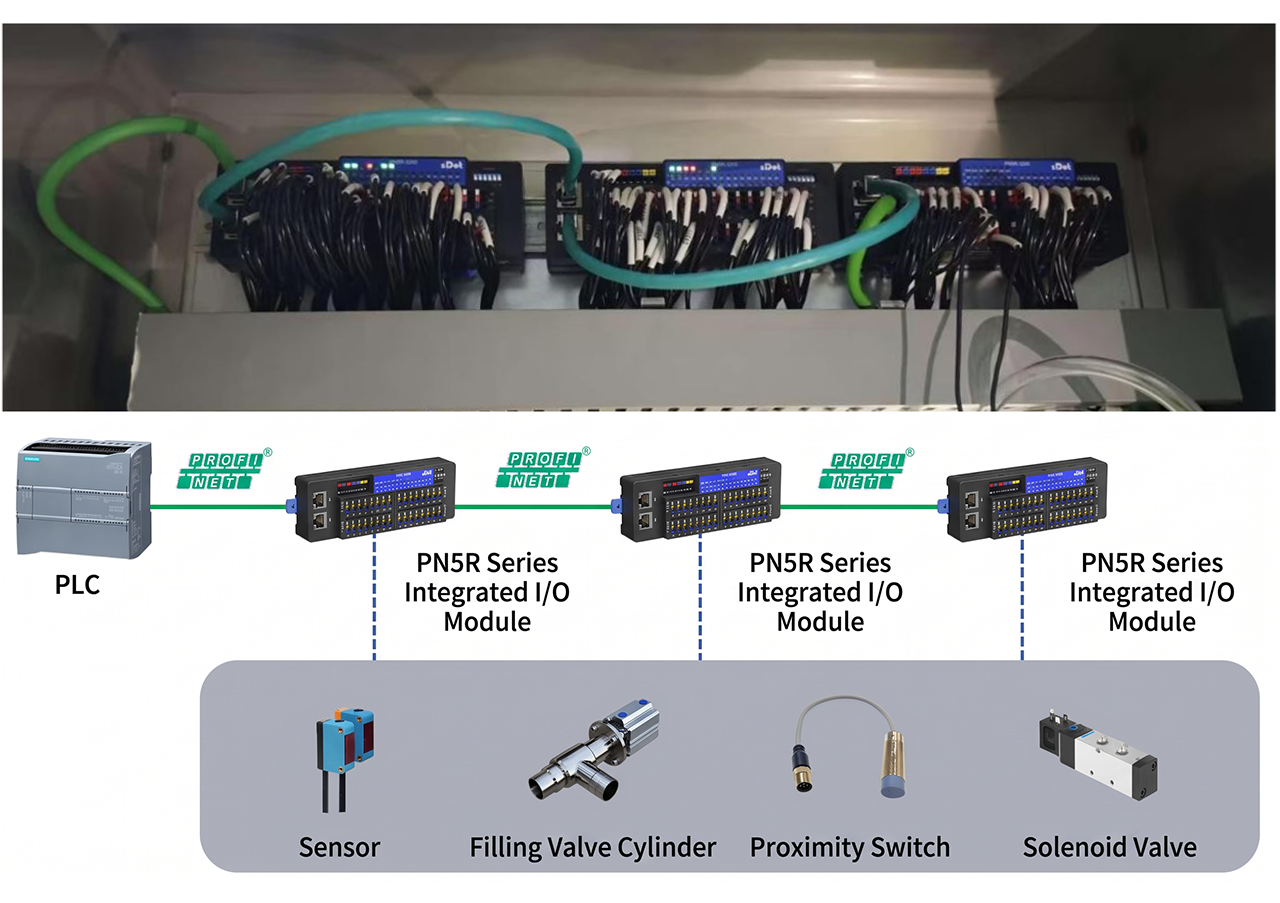
The liquid filling production line uses a Siemens PLC (S7-1200) as the core controller, and the entire line features a long-distance line-type layout. In view of the scattered workstations and fast action cycles of the filling line, this project focuses on two automation control requirements and provides targeted solutions through the Solidot PN5R series integrated I/O module:
Requirement 1: Scattered workstations require greater flexibility in I/O deployment
A large number of sensors and pneumatic actuators are distributed along the filling line, with signal points scattered across a line body tens of meters long. The ideal architecture should allow I/O modules to be connected to the field nearby, shorten signal cable lengths, and enable convenient addition of new stations during line expansion or upgrades.
[Solution] The PN5R series integrated I/O module is used to connect to the Siemens S7-1200 PLC via the PROFINET protocol, building a distributed control architecture. Each module is deployed near its corresponding workstation, field sensor signals are connected nearby, and each workstation is independently configured with stations as needed. The signal cable length across the entire line is significantly reduced, making installation simpler and more efficient; when the production line is expanded later, simply adding the corresponding I/O module Node at the new workstation completes the connection, providing flexible expansion and a controllable cycle.
Requirement 2: Filling accuracy places high demands on communication real-time performance
In the quantitative filling process, the filling valve must complete its open/close action within a short time to ensure filling measurement accuracy and batch consistency. At the same time, parallel actions at multiple workstations require the communication network to have synchronization capability, ensuring product qualification rate and food safety.
[Solution] The PLC communicates with each PN5R integrated I/O module via the PROFINET protocol. Each module collects field signals from its workstation nearby and provides outputs nearby to the actuators of the corresponding workstation, forming a high-speed data link from the controller to the field. This ensures real-time signal transmission and interference resistance, providing support for the consistency of parallel actions at multiple workstations and filling measurement accuracy.
III. Solution Architecture
Control layer: The Siemens S7-1200 PLC serves as the core controller, responsible for overall line logic scheduling, filling data processing, and signal interaction with the actuators at each workstation.
Signal layer: The Solidot PN5R series integrated I/O module is used, with specifications such as 16-point or 32-point digital input/output selected as needed. The module supports direct connection of three-wire sensors without intermediate terminal blocks, effectively freeing up control cabinet space; the output channel drives the actuators at each workstation nearby, achieving efficient field signal acquisition and output.
IV. Application results
Dimension | Application Performance |
Deployment flexibility | The PN5R integrated I/O module connects signals nearby, each workstation is independently configured with stations as needed, the signal cable length across the entire line is significantly reduced, and the installation cycle is greatly shortened |
High filling accuracy | Combined with nearby signal acquisition and output, the filling measurement error is stably controlled within range |
System scalability | The topology supports flexible expansion. Adding a new workstation only requires adding the corresponding I/O module Node to complete the connection quickly, making later upgrades convenient and cost-controllable |
V. PN5R Series integrated I/O modules
The Solidot PN5R series integrated I/O modules combine communication and I/O functions in a single unit with a compact form factor. They support the PROFINET protocol and feature push-in spring terminals for easy wiring. The PCBA is fully conformally coated and fitted with a dust cover, allowing deployment outside the cabinet. The + models allow the DI/DO channels to be configured flexibly, accommodating later production line upgrades. The dual-channel diagnostics architecture supports active fault reporting by the system for fast fault localization.