Knowledge

The Solidot C-series unmanaged industrial Ethernet switches are designed for industrial applications such as small-scale device networking, standalone device communication and point-to-point transmission. The series comprises 8 models covering all combinations of Fast Ethernet versions (HUP) and Gigabit versions (GUP), 5-port and 8-port, and standard versions and PoE-powered versions. No configuration is required — they start working as soon as power is applied.
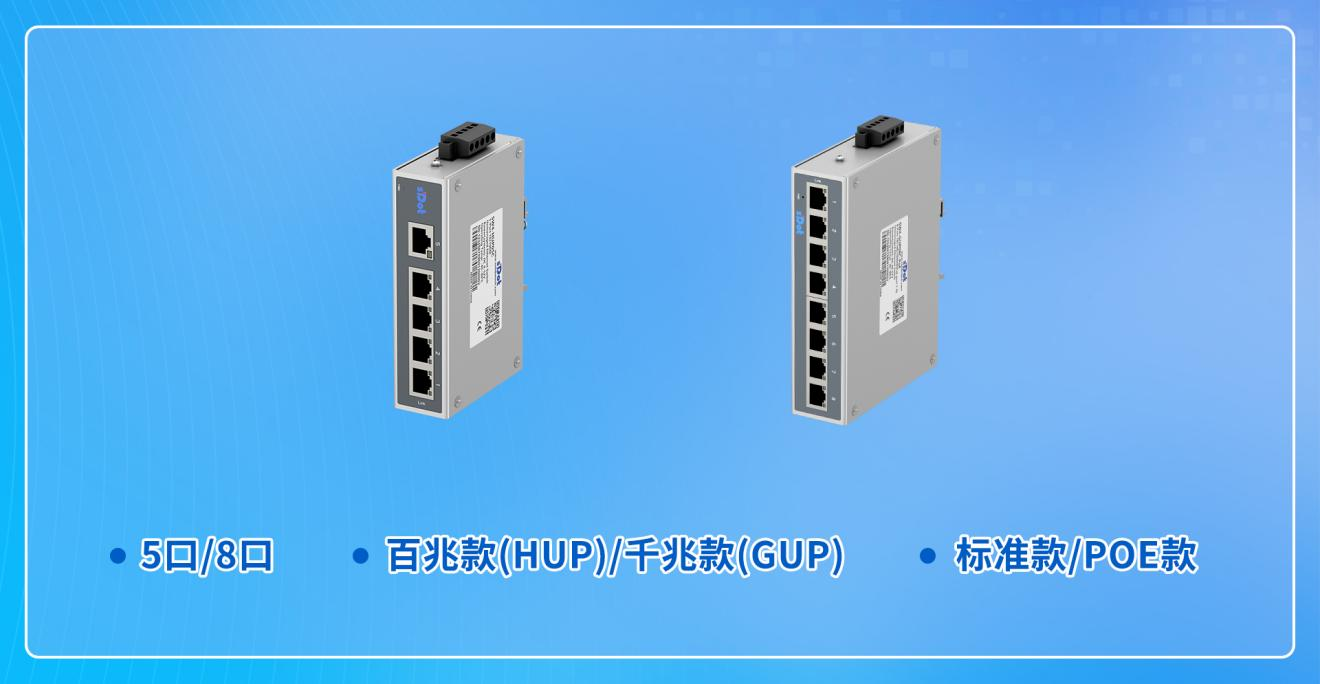
Core parameters at a glance
The design and performance specifications are identical across the entire series:
Parameter | Specification |
Operating temperature | -40 °C ... +80 °C |
Protection rating | IP40, Aluminum Alloy housing |
Installation Method | DIN Rail Mounting/Wall mounting |
Cooling Method | Natural cooling, Fanless |
Switching method | Store-and-forward, Switching delay < 10 µs |
MAC address table | 2K |
Power input | DC 9 ... 52 V, 5-pin Phoenix Contact terminal, Dual power supply redundancy, Reverse connection protection |
power consumption | Standard version power consumption < 3 W; PoE version power consumption < 125 W |
EMC | IEC 61000-4-2/3/4/5/6/16 |
Functions | Full-duplex/Half-duplex Auto-Negotiation, MDI/MDI-X Auto-Sensing, Store-and-forward |
How to choose between Fast Ethernet and Gigabit versions
The Fast Ethernet models (SW4-HUP05C/SW4-HUP08C) cover the communication requirements of conventional industrial control devices such as PLCs, frequency converters and HMIs — the communication bandwidth of such devices rarely exceeds 10 Mbps, so Fast Ethernet switches fully meet the need. The Gigabit models (SW4-GUP05C/SW4-GUP08C) are intended for vision systems, high-volume data acquisition or upstream aggregation scenarios that require higher bandwidth. The main differences between the two are as follows:
100 Mbps models (HUP) | Gigabit models (GUP) | |
Ports Data rate | 10/100 Mbps | 10/100/1000 Mbps |
Buffer | 768 Kbit | 2 Mbit |
Backplane Bandwidth | 1 Gbps | 14 Gbps |
Typical Apply | 100 Mbps → PLC/HMI/frequency converter | Gigabit → vision camera/data acquisition/upstream aggregation |
How to choose between standard models and PoE models?
The C-series standard models and PoE models are identical in industrial-grade design (wide temperature range, IP40, dual power supply redundancy, EMC); the differences lie in the power supply method:
Standard models | PoE models | |
Power Supply Inputs | DC 9 ... 52 V | DC 48 ... 57 V |
PoE Standard | — | IEEE 802.3af (max. 15.4 W)/ 802.3at (max. 30 W), automatic port detection |
PoE Power supply pins | — | V+ (pins 1, 2) V- (pins 3, 6) |
Device power consumption | < 3 W | <= 125 W (including PoE output) |
Ports Indicator | Green (link/data) | Green (link/data) + Yellow-orange (PoE power supply status) |
Applicable scenarios | Connects to Ethernet devices that do not require power, such as PLCs, frequency converters and HMIs | Connects to powered terminals such as IP cameras, wireless APs and vision cameras, transmitting data and power over Ethernet cables |
The PoE versions cover all port count (5-port/8-port) and speed (Fast Ethernet/Gigabit) combinations of the standard versions. Selection takes only two steps: first determine the port count and speed based on the number of devices, then determine whether the terminals require PoE power.
Model quick reference table
Model | Port count | Data rate | Supply voltage | PoE |
5 | Fast Ethernet | 9 ... 52 V | — | |
8 | Fast Ethernet | — | ||
5 | Gigabit | — | ||
8 | Gigabit | — | ||
5 | Fast Ethernet | .. 57 V | 802.3af/at | |
8 | Fast Ethernet | 802.3af/at | ||
5 | Gigabit | 802.3af/at |
8 | Gigabit | 802.3af/at |