Knowledge

Traditional photovoltaic glass plants mostly use manual operations for packaging photovoltaic glass stacks, resulting in low efficiency and high labor intensity. Upgrading to automated packaging can greatly reduce worker labor intensity and labor costs, while significantly improving work efficiency and ensuring the consistency and quality of the packaged products.
Based on the above requirements, automated photovoltaic glass packaging lines have emerged. They can automatically perform strapping, film covering, and film wrapping on stacked photovoltaic glass without manual operation. AGV forklifts can be designed for interfacing at both the front and rear ends to enable automatic loading and unloading of glass stacks.
The Solidot products used in this case study include XB6-PN2002ST, XB6-3200B, XB6-0032B, etc.
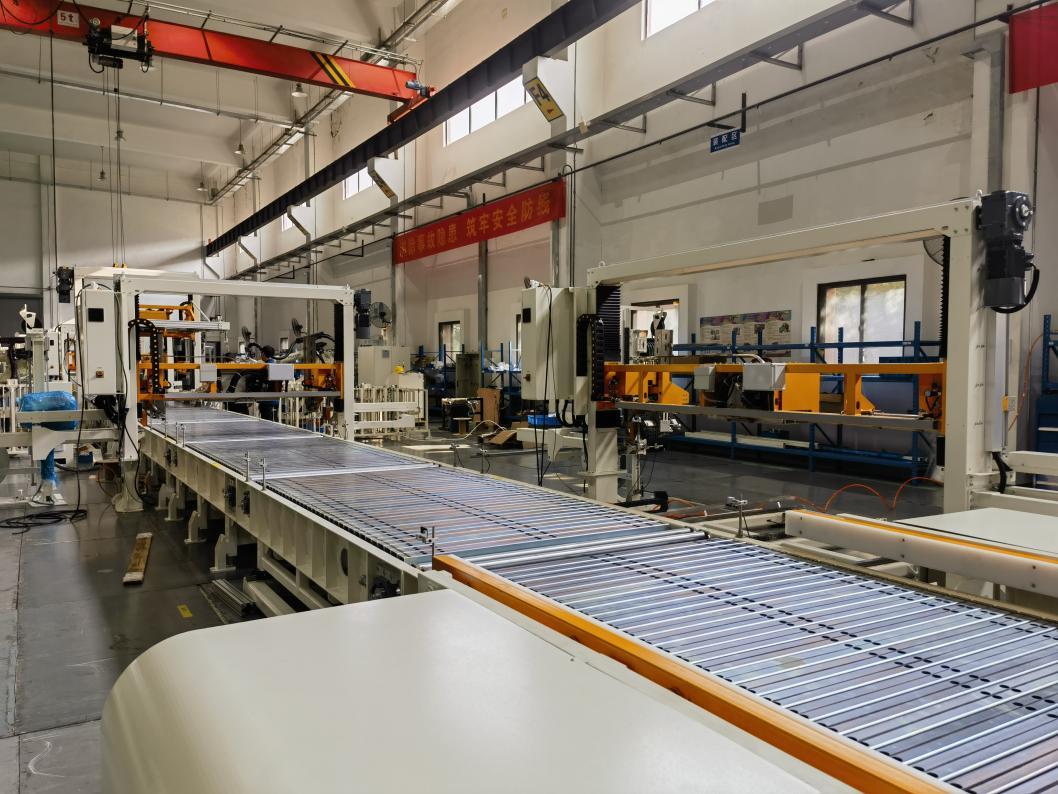
Production process introduction
Process flow: Loading — Centering — Inner long-side strapping — Buffer 1 — Inner short-side strapping — Buffer 2 — Robot loading — Horizontal strapping — Outer long-side strapping — Buffer 3 — Outer short-side strapping — Top film covering — Perimeter film wrapping — Unloading
[Centering mechanism]
This component is driven by a motor-reducer unit via chain transmission. After the push claw contacts the goods, the sensors on both sides of the push claw provide feedback signals. If the deviation between the signals and the goods' set parameters is too large, an alarm signal is issued, and parameters are then corrected manually to ensure the glass stack is in the Target position.
[Long-side strapping machine]
This component straddles the conveyor line and automatically applies edge protectors and performs inner long-side strapping on the goods on the steel pallet, as well as subsequent outer long-side strapping.
[Short-side strapping machine]
This component is arranged on one side of the conveyor line and automatically performs inner short-side strapping on the goods on the steel pallet, as well as subsequent outer short-side strapping.
[Robot workstation]
The robot places the side wooden protectors and top wooden protectors at the set positions on the product. Fencing is installed around the workstation and a safety door is provided. When the safety door is opened, the robot stops working to ensure safety.
[Horizontal strapping machine]
This component straddles the conveyor line. After the protectors are placed, the horizontal frame descends to perform horizontal strapping.
[Film covering machine]
This component is driven by a motor-reducer unit via chain transmission, moving the film covering frame up and down. It automatically adapts to the goods' dimensions based on their length. After film covering, the film is cut with a blade.
[Film wrapping machine]
This component wraps film around the goods on all four sides. Fencing is installed around the wrapping machine and a safety door is provided. When the safety door is opened, the machine stops working to ensure safety.
current pain points
Most processes still require manual execution and place high demands on the operators' professional skills, keeping labor costs persistently high. Manual packaging is also relatively inefficient, and misaligned placement can easily cause the strapping machine's arrow to miss, resulting in considerable material waste.
I/O module application modes
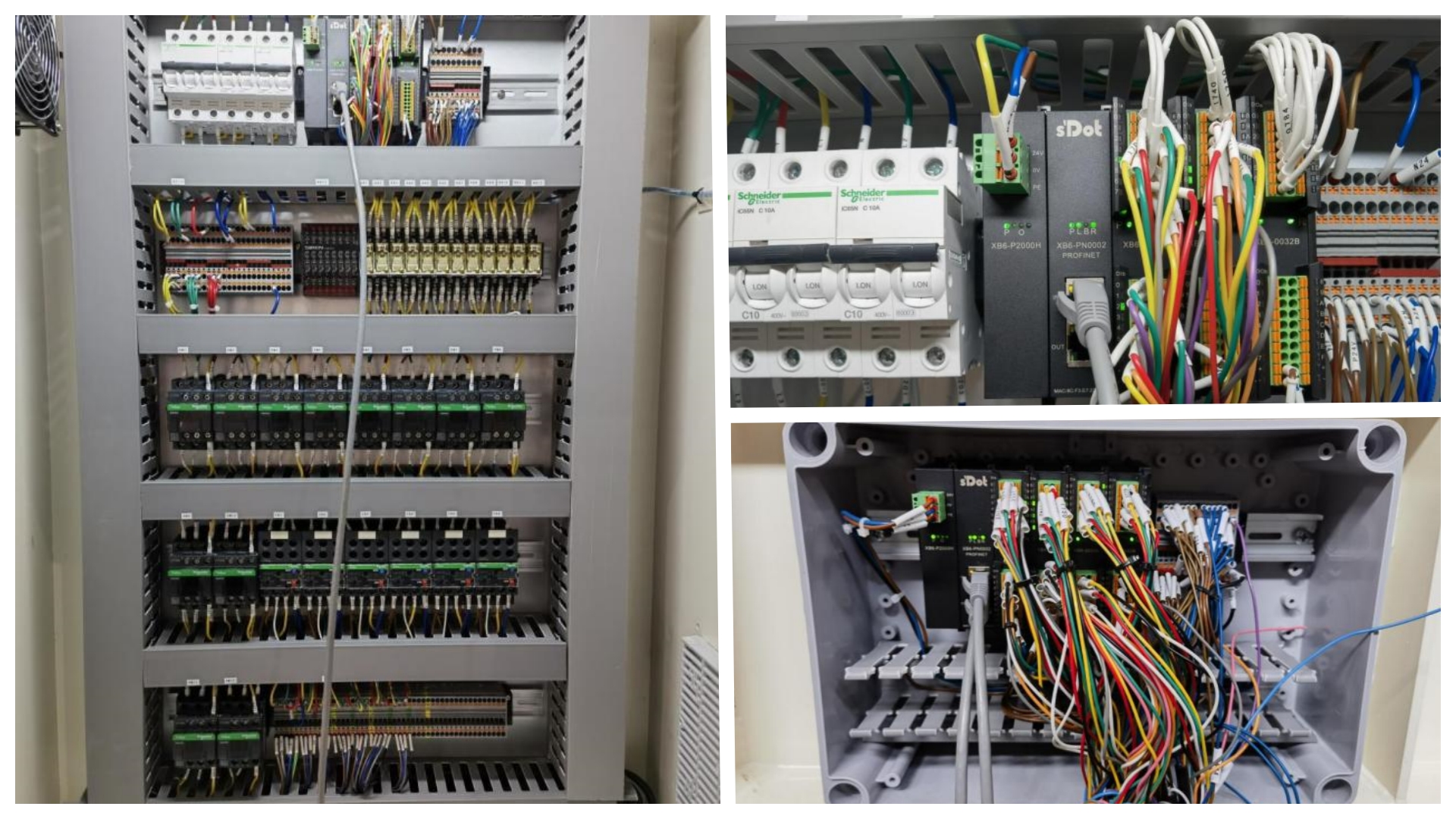
The equipment uses the PROFINET protocol for communication and employs Solidot Slice I/O modules XB6-PN2002ST, XB6-3200B, and XB6-0032B for signal acquisition, transmission, and control. This enables timely detection of errors during the packaging process and accurate compensation and correction, realizing automated packaging for photovoltaic glass palletizing, greatly improving packaging efficiency, ensuring packaging consistency, saving labor costs, and reducing packaging waste.
The controller uses the XB6-0032B digital output module to control the displacement of the hydraulic push plate of the glass stack centering device, so that the glass stack stops accurately at the laterally centered position on the conveyor chain plate line; it controls the Solenoid valve to drive the robot to automatically pick up packaging materials and place them at the corresponding positions on the glass stack for subsequent packaging processes.
The XB6-3200B digital input module is used to acquire position signals at multiple points on the conveyor line (such as sensors on both sides of the pusher claw, proximity sensors, film mark sensors, etc.), enabling multi-point tracking and detection on the production line. When the deviation between the signal and the preset cargo parameters is large, the system promptly issues an alarm signal; if the technical requirements are still not met after a predetermined number of tracking attempts, the system can automatically stop for inspection, avoiding the production of defective products.
product advantages
The Solidot Slice remote I/O module XB6 series offers advantages such as small footprint, fast response, simple installation and wiring, pluggable terminal blocks, easy configuration, and stable operation. Through the above application, it provides a stable and cost-effective solution for the photovoltaic glass automated packaging production line.
Solidot has also introduced a new generation of Slice I/O — the XB6S series, which features excellent noise immunity and ease of use. In addition, there are integrated I/O modules suitable for distributed small-point signal control, IO-Link fieldbus I/O with IP67 protection rating, Fieldbus Valve terminals, and other products. The rich product portfolio can meet diverse and complex on-site customer requirements, delivering a better user experience.