Knowledge

The fully automatic lithium battery drying line is a core part of power battery production. It controls the moisture content of the batteries through a vacuum baking process to ensure cell performance and safety. The line integrates multiple automated processes such as code scanning and identification, robotic arm loading and unloading, transfer, vacuum baking and quality inspection, enabling continuous and efficient processing of cells from loading to completion of baking.
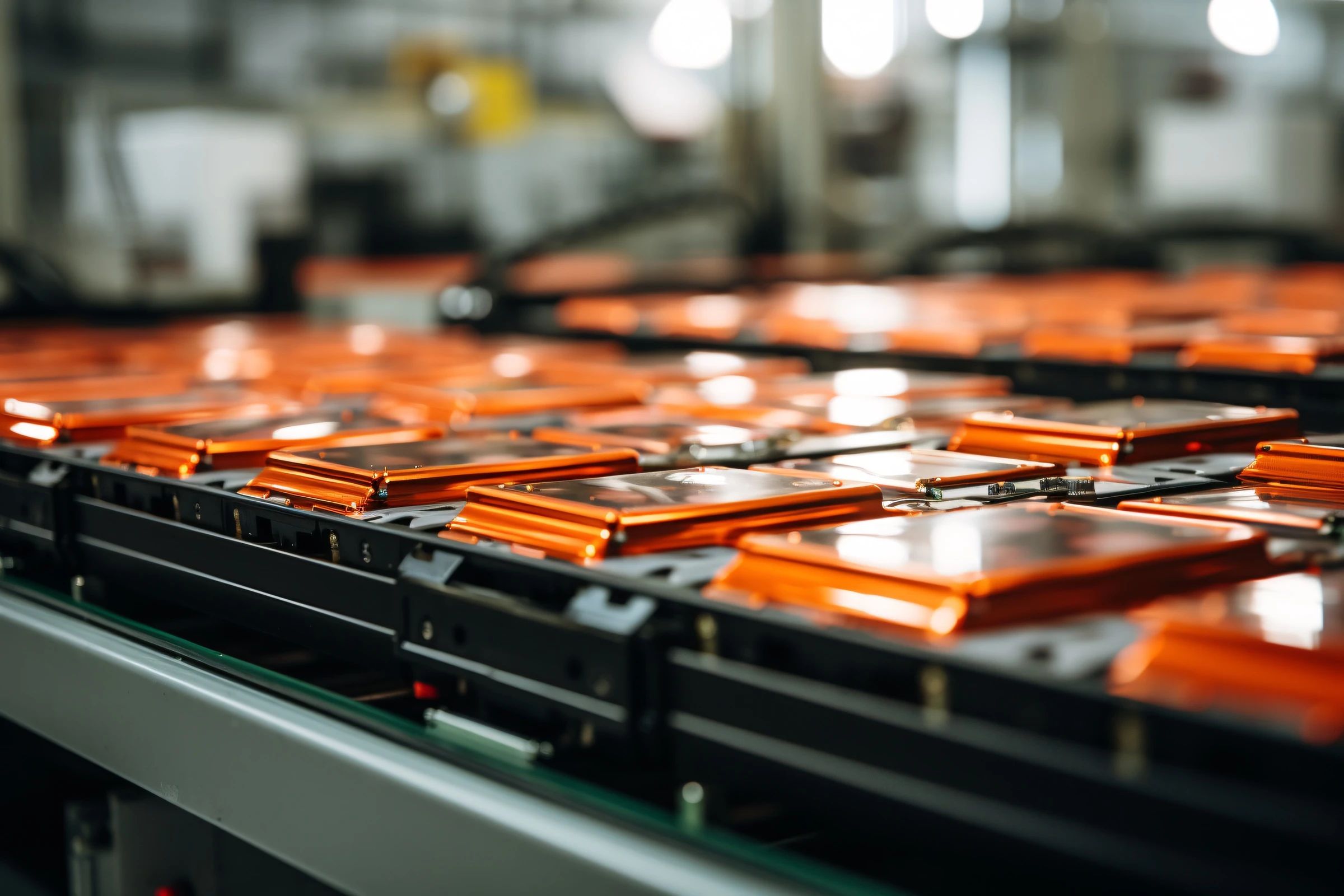
1. Production process Introduction
Workflow of the fully automatic lithium battery drying line: battery code scanning → battery loading onto fixture → fixture transfer → vacuum baking → battery unloading from fixture
[Battery code Scanning]
Before the battery enters the drying line, the code scanning device automatically reads the cell code to provide data support for process parameter matching and quality traceability.
[Battery Loading onto Fixture]
The robotic arm picks up the battery and secures it to a dedicated fixture. Positioning sensors are built into the fixture to ensure precise alignment between the cell and the baking chamber, preventing uneven baking caused by posture deviation.
[Fixture Transfer]
The fixture is transferred to the vacuum baking chamber. During transfer, position signals and limit feedback must be monitored in real time to ensure the transport path is free of collisions and deviations.
[Vacuum Baking]
After the chamber is evacuated, high-temperature baking starts. The system simultaneously acquires parameters such as temperature, pressure and time, and dynamically adjusts the heating power and vacuum valve opening to ensure moisture removal efficiency and process consistency.
[Battery Unloading from Fixture]
After baking is complete, the robotic arm unloads the battery and checks its conformity. The fixture returns to its initial station for reuse.
2. I/O module Application mode
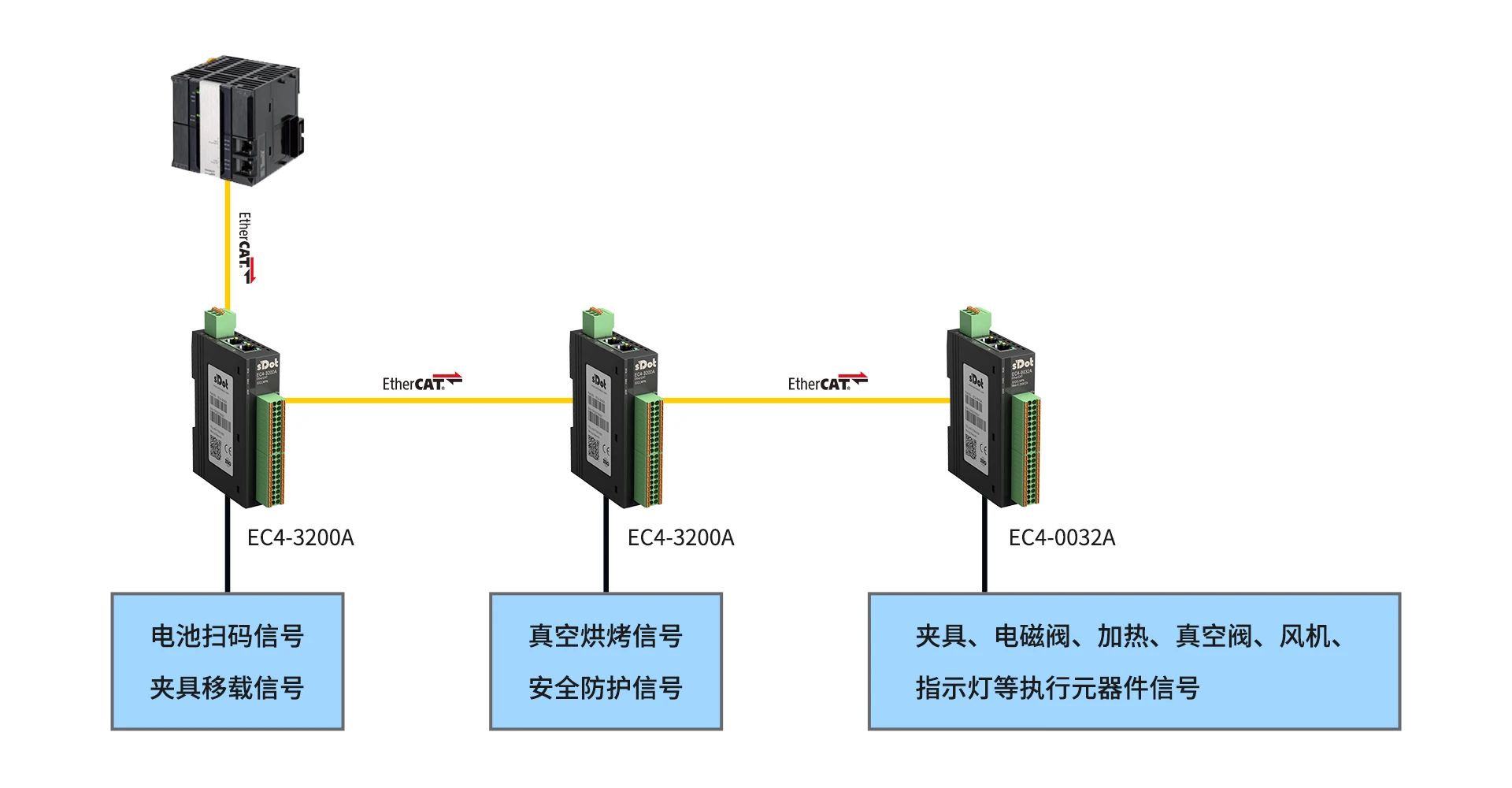
The fully automatic lithium battery drying line uses the EtherCAT protocol and an Omron NJ series PLC, and is connected to Solidot integrated remote I/O digital input modules EC4-3200A and digital output modules EC4-0032A. A single module can cover the requirements of multiple stations. The specific applications are as follows:
EC4-3200A (32-channel digital input)
Battery code scanning: acquires the trigger signal and code scanning completion feedback;
Fixture transfer: acquires the fixture-in-position and transfer mechanism Limit signal;
Vacuum baking: acquires signals such as vacuum pump start/stop, chamber door interlock switch and temperature over-limit alarm;
Safety protection: integrates safety signals such as the emergency stop button and safety light curtain.
EC4-0032A (32-point digital output)
Execution control: signals for transfer fixture clamping, solenoid valve release, heating element on/off, vacuum valve open/close, fan start/stop, indicator status switching, etc.
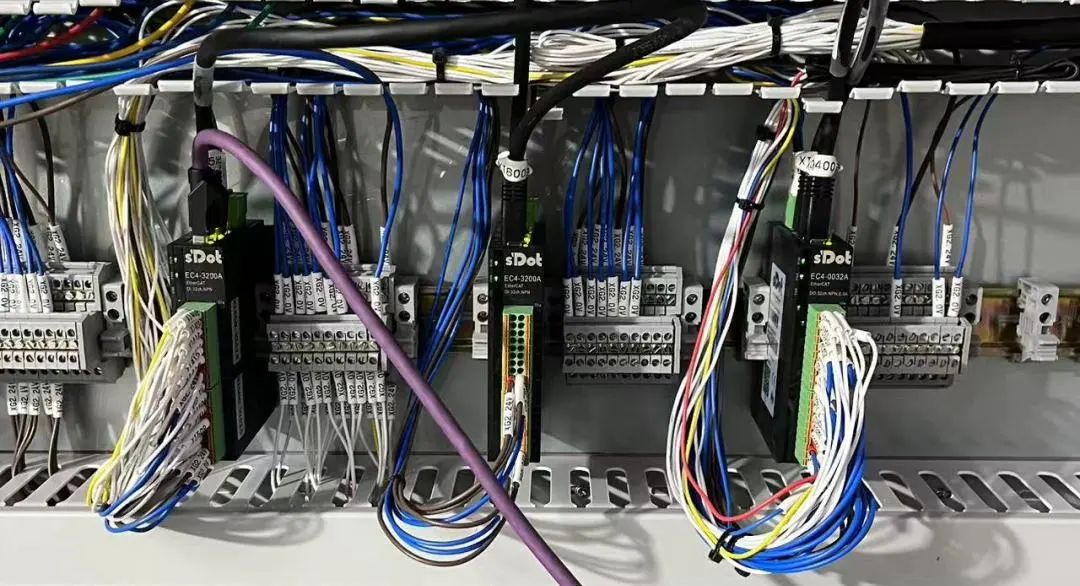
3. Reference topology
[PLC]Omron NJ series
[Industry]Lithium battery fully automatic drying line
[Project configuration]EC4-3200A, EC4-0032A
4. Optimization results
The Solidot integrated remote I/O modules EC4-3200A and EC4-0032A meet the customer's I/O system requirements with distributed points thanks to their small size, compact design and high communication speed. At the same time, these modules simplify wiring and reduce maintenance costs, providing highly reliable support for large-scale production.