Knowledge

As the number of devices in an industrial network increases, the source of broadcast frames is no longer controllable. When a node malfunctions and continuously sends broadcast frames, the broadcast traffic can saturate the entire bandwidth of the network segment, causing communication interruption for the remaining devices—this is a broadcast storm. The solution lies not at the configuration level, but at the hardware level.
The Solidot D series unmanaged industrial Ethernet switches are designed for exactly this purpose, covering the full range of Fast Ethernet and Gigabit, 5 to 16 ports, and purely electrical ports and SFP fiber ports. Building on Plug and Play, broadcast storm suppression is implemented via a DIP switch.
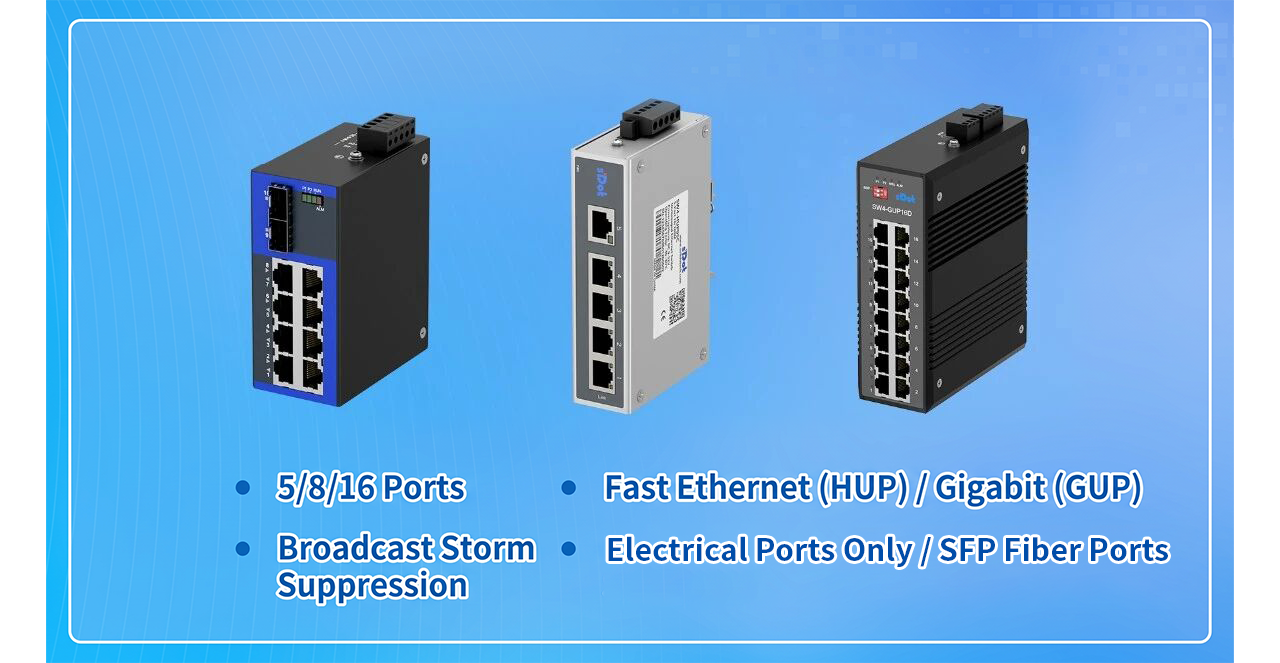
Core parameters at a glance
Parameter item | Specification |
Operating temperature | -40 ... +80 °C |
Protection rating | IP40, metal housing (thickened aluminum alloy for the 16-port version) |
Installation Method | DIN rail mounting/wall mounting |
Cooling Method | Natural cooling, fanless |
Switching method | Store-and-forward, switching delay <= 7 µs |
Power input | DC 9 ... 56 V, 5-pin Phoenix Contact terminal, dual power supply redundancy, reverse connection protection |
EMC | IEC 61000-4-2/3/4/5/6/16 |
Certification | CE, RoHS |
MTBF | >= 300,000 hours |
Broadcast Storm Suppression | 2-position DIP switch, hardware-level control |
If there are more than 10 devices on site, or if broadcast traffic of uncertain origin exists in the network, the broadcast storm suppression and enhanced EMC protection of the D series provide a more robust safety baseline.
How to choose between Fast Ethernet and Gigabit (5/8 ports)?
The Fast Ethernet models (SW4-HUP05D, SW4-HUP08D) cover the communication requirements of conventional industrial control devices such as PLCs, frequency inverters and HMIs. The Gigabit models (SW4-GUP05D, SW4-GUP08D) target scenarios requiring higher backplane bandwidth, such as vision systems, large-scale data acquisition or upstream aggregation. The main differences between the two are as follows:
Comparison Item | Fast Ethernet (HUP) | Gigabit (GUP) | ||
SW4-HUP05D | SW4-HUP08D | SW4-GUP05D | SW4-GUP08D | |
Port speed | 10/100 Mbps | 10/100/1000 Mbps | ||
Buffer | 768Kbit | 1Mbit | 2Mbit | 1.5Mbit |
Backplane bandwidth | 1 Gbps | 1.6 Gbps | 14 Gbps | 16 Gbps |
MAC address table | 2K | 2K | 2K | 4K |
power consumption | < 5 W | < 5 W | < 5 W | < 5 W |
How to choose between 16 ports and SFP fiber ports?
The 16-port models (SW4-HUP16D, SW4-GUP16D) feature a standalone housing and are suitable for scenarios with centralized access of multiple devices. Both models integrate a relay alarm output: one NO + one NC, contact capacity 1 A@DC 24 V, which can be used for external audible and visual alarms or host computer monitoring. The main parameters are as follows:
SW4-HUP16D | SW4-GUP16D | |
Ports | 16 x Fast Ethernet | 16 x Gigabit |
Buffer | 4.1 Mbit | 4.1 Mbit |
Backplane bandwidth | 3.2 Gbps | 52 Gbps |
MAC address table | 8K | 8K |
power consumption | < 8 W | < 8 W |
The SFP models (SW4-GUP04D-SFP2, SW4-GUP08D-SFP2) add SFP fiber ports to the Gigabit Ethernet ports, enabling long-distance fiber-optic transmission. Main parameters are as follows:
Parameter | SW4-GUP04D-SFP2 | SW4-GUP08D-SFP2 |
Port | 4 copper + 2 SFP | 8 copper + 2 SFP |
Buffer | 4.1 Mbit | 4.1 Mbit |
Backplane bandwidth | 24 Gbps | 24 Gbps |
MAC address table | 8K | 8K |
Jumbo Frame | Supports 10K | Supports 10K |
SFP | DDM auto-detection of optical module rate | DDM auto-detection of optical module rate |
Power Supply | Dual DC 9 ... 56 V or AC 24 V | Dual DC 9 ... 56 V or AC 24 V |
power consumption | < 5 W | <5 W |
Model Quick reference table
Model | Number of ports | Speed | Special form factor |
SW4-HUP05D | 5 | Fast Ethernet | — |
SW4-HUP08D | 8 | Fast Ethernet | — |
SW4-GUP05D | 5 | Gigabit | — |
SW4-GUP08D | 8 | Gigabit | — |
SW4-HUP16D | 16 | Fast Ethernet | — |
SW4-GUP16D | 16 | Gigabit | — |
SW4-GUP04D-SFP2 | 4 electrical + 2 SFP | Gigabit | fiber ports |
SW4-GUP08D-SFP2 | 8 electrical + 2 SFP | Gigabit | fiber ports |