Knowledge


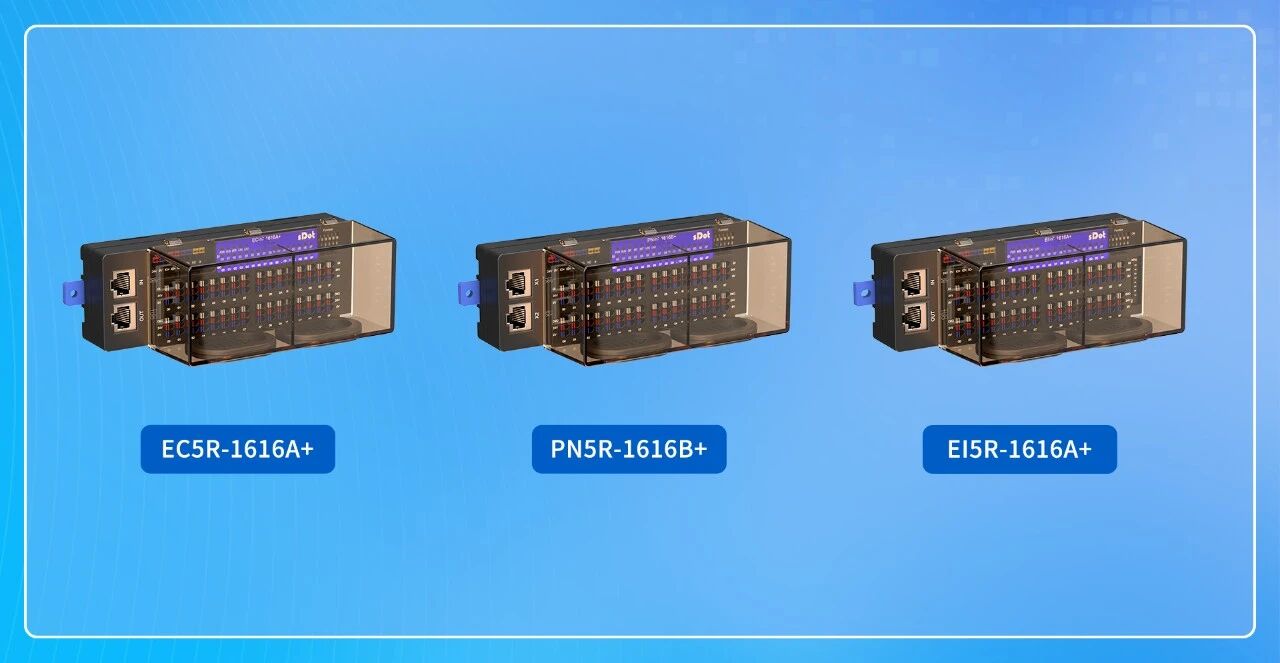
The Solidot 5 Series integrated I/O family now covers industrial Ethernet protocols such as EtherCAT, PROFINET and EtherNet/IP, with 16 and 32 channel versions, and is compatible with master systems from all major vendors.
The configurable models with the "+" suffix are designed to meet on-site I/O specification changes: the module channels can be configured as input or output via DIP switch — sensor polarity (NPN/PNP) changes and reassignment of input and output points can both be completed on the same module, and the I/O assignment can be determined according to actual on-site requirements.
How the configurable function is implemented
Take the EC5R-1616A+ as an example: the module has a total of 32 channels, of which 16 are fixed NPN inputs and the other 16 are DI/DO compatible channels — the compatible channels can be configured as inputs or outputs via the Binary DIP Switches on the panel. Add inputs when input points are insufficient, add outputs when output points are insufficient; a single module can cover a wide range of I/O specification requirements.
The operation is summarized as follows —
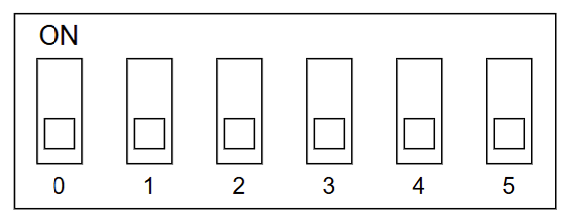
● DIP switch 0: determines the module version. When set to the alarm version, the alarm code can be viewed in the upstream data, facilitating fault troubleshooting;
● DIP switch 1: determines the DI/DO assignment mode;
● DIP switches 2 ... 5: configure the channels in groups;
● After a configuration change, power-cycle the entire group for it to take effect.
Configurable DI/DO DIP Switch setting table (effective when Binary DIP Switch 1 is set to 0) | |
DIP Switch 2 setting (Binary) | 0: Channels 00 ... 03 are output DO |
1: Channels 00 ... 03 are input DI | |
DIP Switch 3 setting (Binary) | 0: Channels 04 ... 07 are output DO |
1: Channels 04 ... 07 are input DI | |
DIP Switch 4 setting (Binary) | 0: Channels 08 ... 0B are output DO |
1: Channels 08 ... 0B are input DI | |
DIP Switch 5 setting (Binary) | 0: Channels 0C ... 0F are output DO |
1: Channels 0C ... 0F are input DI | |
In addition to DIP switch configuration, the module also supports automatic input/output adaptation based on the wiring method.
II. Naming Convention for Configurable Models
In the model naming, "A" corresponds to the NPN output system and "B" to the PNP output system, selectable according to the signal polarity of the on-site sensors and actuators; configurable-function models carry a "+" suffix after "A" or "B".
III. Other Key Features
Besides the configurability, the series also offers the following features in terms of communication, installation and environmental adaptability:
● Communication performance: EC5R minimum cycle time 250 µs; PN5R minimum cycle time 1 ms; EI5R minimum cycle time 2 ms; all three have a transmission rate of 100 Mbps.
● channel diagnostics: the channel indicators are arranged directly alongside the channels, so signal faults can be quickly traced to the specific channel.
● Protection mechanisms: the outputs have short-circuit protection and reverse connection protection, both with automatic recovery; the module also has reverse polarity protection and surge protection, with an isolation withstand voltage of 500 V AC between channels.
● Load capacity: maximum 0.5 A per output channel, supporting resistive, inductive and lamp loads, and capable of directly driving standard solenoid valves, relays and indicators.
● terminal blocks: the I/O signal terminals use a 3-pin design, with each channel wired as an independent group, saving terminal block space; sensors can be powered directly from the terminals.
● Installation method: DIN 35 mm rail mounting is supported; the module also has retractable structural parts at both ends and can be mounted via screw holes.
● Environmental adaptability: operating temperature -20 °C ... +60 °C, IP20 protection rating, suitable for installation inside control cabinets, with an optional dust cover.