Knowledge


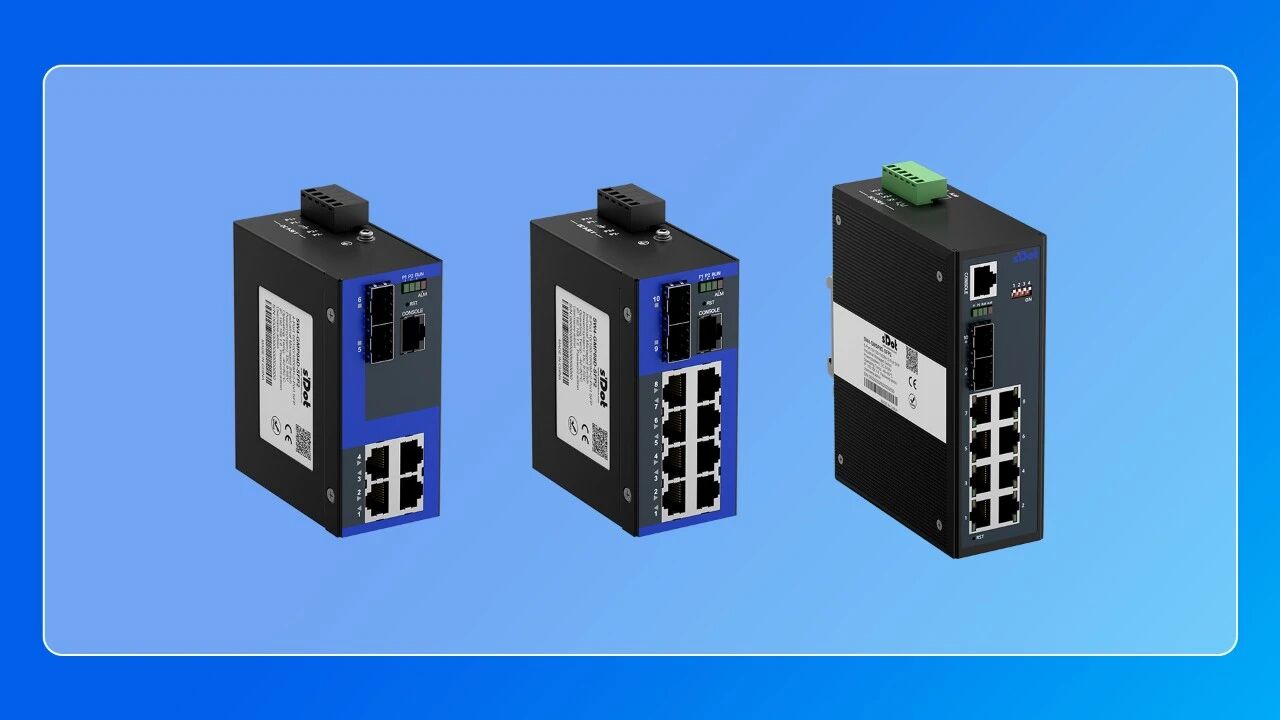
The Solidot D series managed industrial switches comprise 3 models: SW4-GMP04D-SFP2, SW4-GMP08D-SFP2 and SW4-GMSP8D-SFP2. All are Layer 2 managed ring network switches, each equipped with 2 Gigabit SFP Fiber ports, support the STP/RSTP/ERPS ring network protocols, and have an ERPS self-healing time of less than 50 ms. The two GMP models are lightly managed, while the GMSP model is fully managed.
Core parameters at a glance
The design and performance specifications shared by the three models are as follows
Parameter | Specification |
Port speed | 10/100/1000BaseT (X) auto detection, full/half duplex, MDI/MDI-X auto-sensing |
SFP Fiber Port | 2 Gigabit SFP ports, supporting DDM auto-detection of optical module speed |
Operating temperature | -40 °C ... +80 °C |
Storage temperature | -40 °C ... +85 °C |
Relative humidity | 5 % ... 95 %, non-condensing |
Protection rating | IP40 |
Installation Method | DIN rail mounting/wall mounting |
Cooling Method | Natural cooling, fanless |
Switching method | Store-and-forward, switching delay <= 7 µs |
Power input | Dual DC 9 ... 56 V or dual AC 24 V, Phoenix Contact terminal |
Power supply protection | Dual power supply redundancy, built-in 4.0 A overcurrent protection, overvoltage and reverse connection protection |
power consumption | < 10 W |
EMC | IEC 61000-4-2/3/4/5/6/16 |
Certification | CE, RoHS, ISO9001 |
Choosing between lightly managed and fully managed
The two GMP models are Layer 2 lightly managed and cover common management functions such as Ring network, VLAN and QoS; the GMSP model is Layer 2 fully managed and extends the lightly managed feature set with networking, security and remote maintenance capabilities. The main functions are compared as follows:
Management functions | (Lightly Managed) | (Fully Managed) |
Ring network protocol | STP/RSTP/ERPS Self-healing time < 50 ms Recommended ring network size: no more than 30 units | STP/RSTP/ERPS (ERPSv1/v2) Self-healing time < 50 ms ERPS with aggregation ports supported |
VLAN | Port VLAN Voice VLAN Surveillance VLAN | 4K VLAN entries, port VLAN, GVRP, Double VLAN, up to 8 Layer 3 Logical interfaces for VLANs |
QoS | DSCP Mapping WRR/WFQ Scheduling Port Priority | 802.1P/DSCP Priority Remarking, SP/WRR/WFQ Scheduling |
Multicast | IGMP Snooping | IGMP Snooping, GMRP |
Link Aggregation | Manual aggregation Up to 4 aggregation groups | Manual aggregation and LACP |
Port Mirroring | Up to 4 mirroring sessions | Supported |
DHCP | DHCP Snooping | DHCP Server DHCP Client DHCP Snooping |
SNMP | SNMPv1/v2c | SNMPv1/v2/v3 |
Remote management | Web, Console | Web, Console, Telnet, SSH |
Security | Limit on number of MAC addresses learned Kbps/PPS storm suppression Cable Diagnostics | 802.1X Authentication (EAP/CHAP/PAP) Port Security (up to 3 MAC bindings) |
All three models support device IP configuration, port status monitoring, optical module transmit/receive power monitoring and MAC address Management.
How to set up a ring network
STP and RSTP are Spanning Tree protocols that eliminate loops by blocking redundant links and reconverge after a link failure; ERPS is an Ethernet ring protection protocol with a self-healing time of less than 50 ms when a link is interrupted, making it suitable for ring topologies with high recovery-speed requirements. Long-distance links in the ring network can be handled by 2 SFP Fiber ports, which support DDM Auto-detection of the optical module rate.
Model quick-reference table
Model | Port | Management level | MAC Address table | Buffer | Backplane Bandwidth |
4× Gigabit Ethernet port + 2× SFP Fiber port | Layer 2 lightly managed | 8K | 4.1 Mbit | 24G | |
8× Gigabit Ethernet port + 2x SFP Fiber port | Layer 2 Lightly Managed | 8K | 4.1 Mbit | 24G | |
8x Gigabit Ethernet port + 2x SFP Fiber port | Layer 2 Fully Managed | 8K | 4 Mbit | 40G |