Knowledge


XB6S-PL20D is a 2-channel Incremental Encoder Counter module of the XB6S series. It can be connected to two external 5 V differential incremental encoders and reports the real-time speed. It is compatible with XB6S series couplers and offers three selectable pulse modes: AB Quadrature (ABZ), Pulse+direction (Pul+Dir), and Dual Pulse (CW/CCW). It supports functions such as Z-phase reset, compare output, and probe latch.

1. Application example
The stator winding machine is a key piece of equipment in motor manufacturing, used to wind copper wire precisely onto the stator core. The winding quality directly affects the performance and efficiency of the motor. During operation, a robot arm or conveyor feeds the stator core into the winding station, the Servo Motor moves according to the trajectory set by the program, and the winding head winds the copper wire into the slots of the core in the preset number of turns and layers.
The Solidot XB6S-PL20D module precisely acquires the Phase A and Phase B quadrature pulse signals of the encoder (built into the Servo Motor) to obtain direction and speed information, while the Z-Phase signal is used to provide a reference point, ensuring an accurate start position for winding. Together with the Servo Motor, it implements Closed-loop control, enabling real-time monitoring and adjustment of the rotation speed and winding position, which ensures winding quality.
XB6S-PL20D is also widely used in industrial automation, robotics, CNC machine tools, and other applications requiring differential signal incremental encoders.
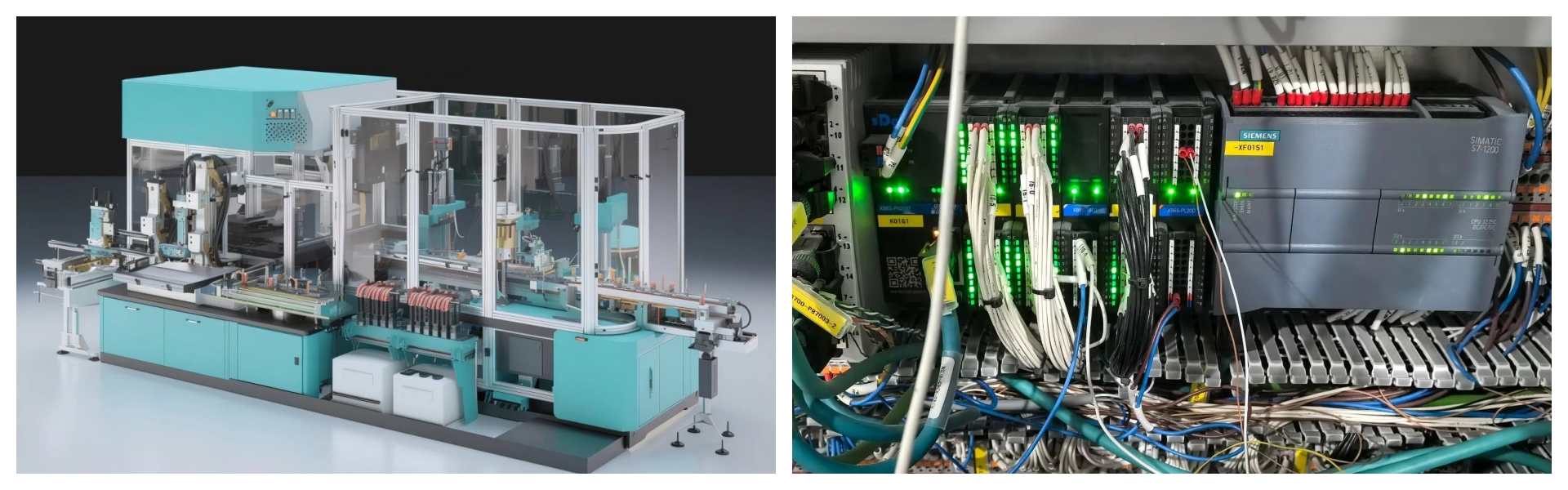
Left: stator winding machine, right: XB6S-PL20Dfield application
2. Panel structure and wiring diagram

Left: XB6S-PL20Dpanel structure, right: XB6S-PL20Dwiring diagram
3. Parameter overview
Interface parameters | |
Product Model | |
Bus protocol | X-bus |
Process Data Size: Output (Downstream) | 20 Bytes |
Process Data Size: Input (Upstream) | 34 Bytes |
Channel Type | Encoder input channels: 2 channels (Phase A, Phase B, and Phase Z), 5 V differential |
Probe input channels: 4 channels (1 encoder with 2 probe functions), PNP/NPN | |
Standard digital input channels: 2 channels (1 encoder with 1 standard digital input), PNP/NPN | |
Compare output channels: 4 channels (1 encoder with 2 compare outputs), NPN | |
Standard digital output channels: 4 channels (1 encoder with 2 standard digital outputs), NPN | |
Refresh rate | 1 ms |
Technical Specifications | |
System Power Supply | 5 V DC (4.5 V ... 5.5 V) |
Rated current consumption | 130 mA |
power consumption | 0.65 W |
Field-side power supply rating (range) | 24 V DC (20.4 V ... 28.8 V) |
Input channel voltage rating (range) | 24 V DC (20.4 V ... 28.8 V) |
Encoder pulse input mode | AB Quadrature (ABZ), Pulse+direction (Pul+Dir), Dual Pulse (CW/CCW) |
Encoder pulse input frequency | Max. 1 MHz |
Reports channel real-time speed | Supported |
Z-phase reset | Supported |
Counting Multiplier Setting | 4x/2x/1x (default 1x) |
Ring counting | Supported |
Counting Range | .. 2^32-1 or 0 ... ring counter resolution x counting multiplier - 1 |
Encoder Ring Counter resolution setting [1] | Supported (ring counter resolution setting range: 1 ... 65535) |
Initial Count Value Setting | Supported (initial count value setting range: 0 ... 2^32-1) |
Reverse Counting | Supported |
Encoder input hardware filter | Supported (levels 0 ... 15) |
Probe function (high-speed hardware latch) | Supported |
Probe input frequency | 1 MHz |
Comparison Output Function | Supported |
Comparison of output signal response speed | < 10 µs |
I/O Pin Function Selection | Supported |
Power-off storage | Supported |
Dimensions | 106.4 x 25.7 x 72.3 mm |
Weight | 110 g |
Wiring Method | Screwless quick connector |
Installation Method | 35 mm standard DIN rail mounting |
Operating temperature | -20 °C ... +60 °C |
Storage temperature | -40 °C ... +80 °C |
Relative humidity | 95 %, non-condensing |
Protection rating | IP20 |
Note [1]: The ring counter resolution here is used only to set the encoder ring counting range and is different from the physical resolution of the encoder itself. | |