Knowledge

Application of the Solidot EtherCAT remote I/O in the aspect of appearance inspection and measurement of machined parts
In recent years, with strong national support, the "Made in China 2025" strategy has achieved notable results, and China's intelligent manufacturing has developed rapidly. Machinery manufacturing has leveraged automation technology to upgrade equipment, enabling equipment to carry out continuous automatic production, machining and optimization processes. Digital transformation across all industries has yielded encouraging results.
Empowered by automation technology, traditional industry has achieved a qualitative leap in terms of high quality, high volume and improved work efficiency. Taking two practical cases of 2D cameras and 3D profile scanners in industrial inspection as an entry point, this article describes in detail the high-quality solutions provided by Solidot remote I/O, and also demonstrates Solidot's pioneering spirit under the banner of intelligent manufacturing.
Application of Solidot remote I/O in a 2D camera system
1. Precision inspection equipment controlled by an Omron NX1P2 PLC
The precision small-part inspection instrument uses a Hikvision industrial 2D camera. For different fields of view and different product sizes, the camera is positioned up and down by a servo drive, enabling it to handle the inspection of different products.
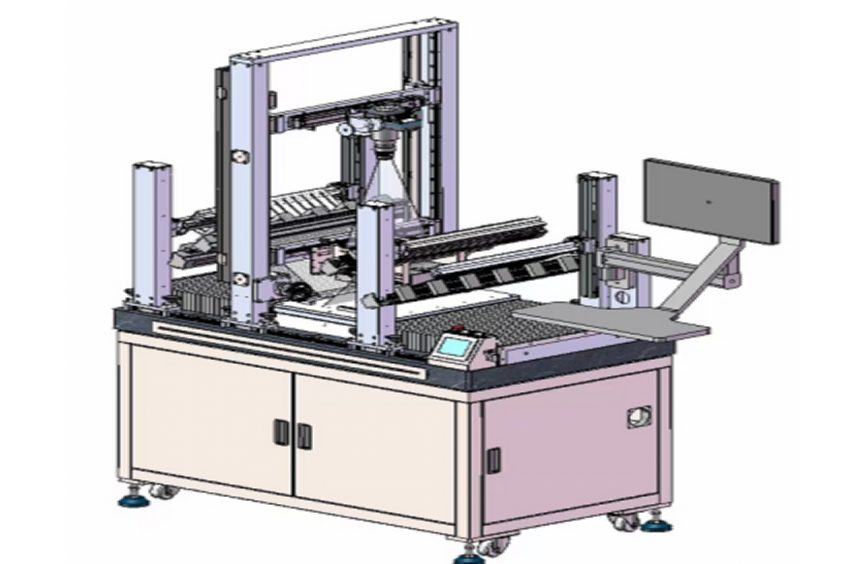
▲ Precision part inspection equipment
2. Description of the control principle and system block diagram
The inspection equipment uses an Omron NX1P2 PLC as the EtherCAT Master to control a servo drive that moves the Hikvision 2D camera up and down; the peripheral digital signals, such as the product detection photoelectric signal, the upper and lower limits and home signal of the servo, and the peripheral pushbutton and indicator signals, are acquired via 2 Solidot EC4-1616A remote I/O modules.
Communication with the Hikvision 2D camera is carried out via Omron's Fins protocol, triggering the camera to take a picture. The resulting image is then processed by the camera's algorithm, and the final OK and NG signals are reported to the PLC. If the PLC receives an NG signal, the output signal of the Solidot EC4-1616A remote I/O module drives an alarm light for an alarm indication.
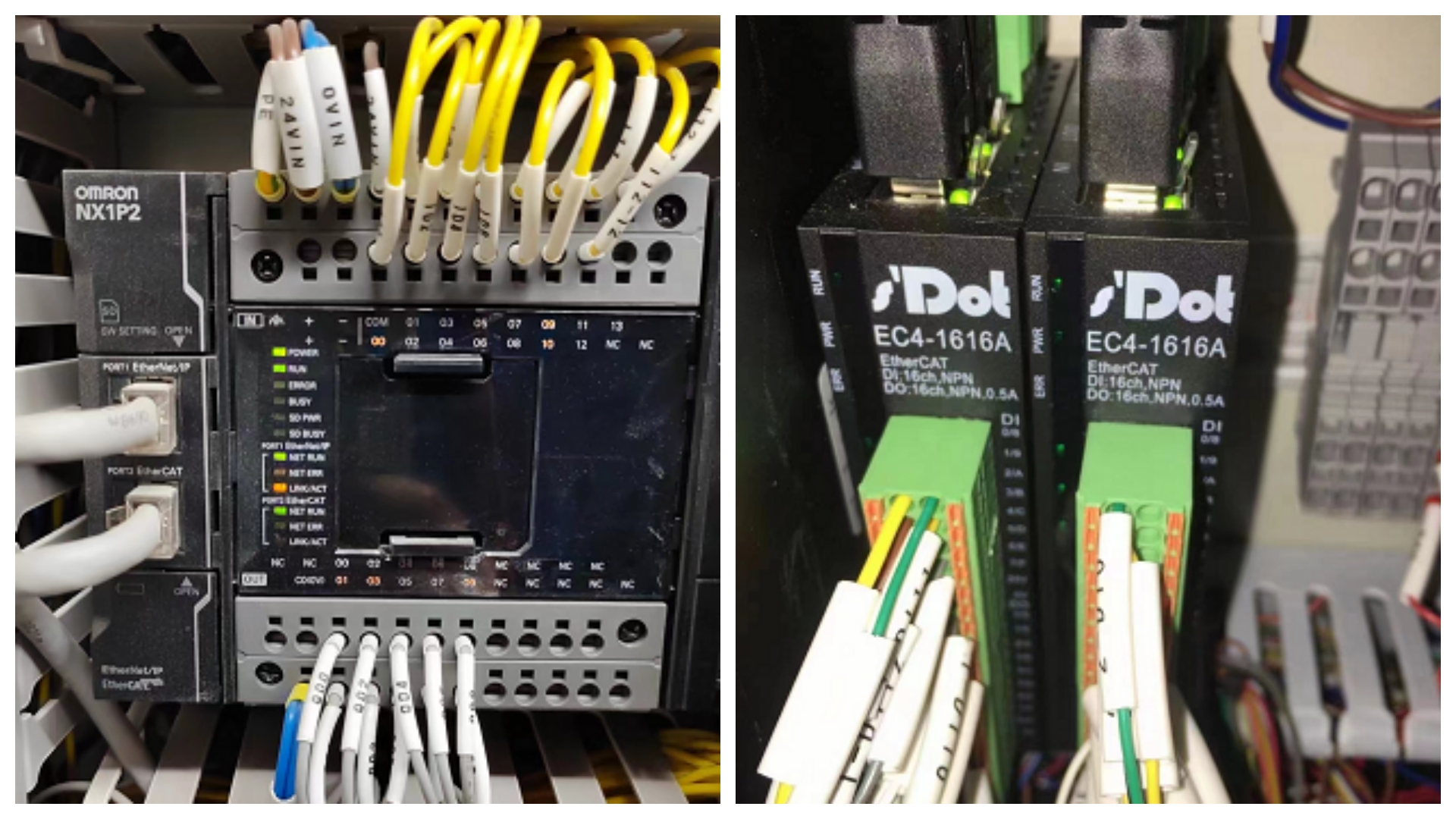
▲ PLC and remote EC4-1616A
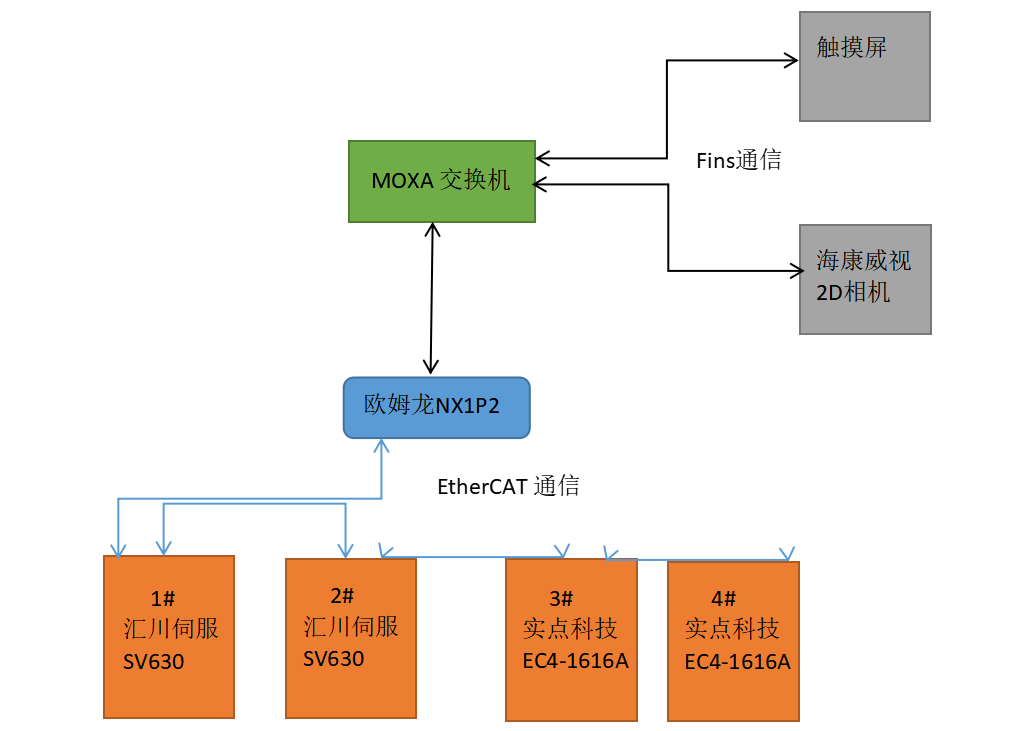
▲ Electrical control system block diagram
Application of Solidot remote I/O in a 3D profile scanner
1. 3D profile scanner equipment controlled by a Keyence KV-8000 PLC
The inspection equipment uses a KUKA robot to pick material from the infeed conveyor, then place it on the selection table for inspection. After inspection, the robot picks it up and moves it to a rotary positioner for inspection, and finally the robot picks the material up and places it on the outfeed conveyor.
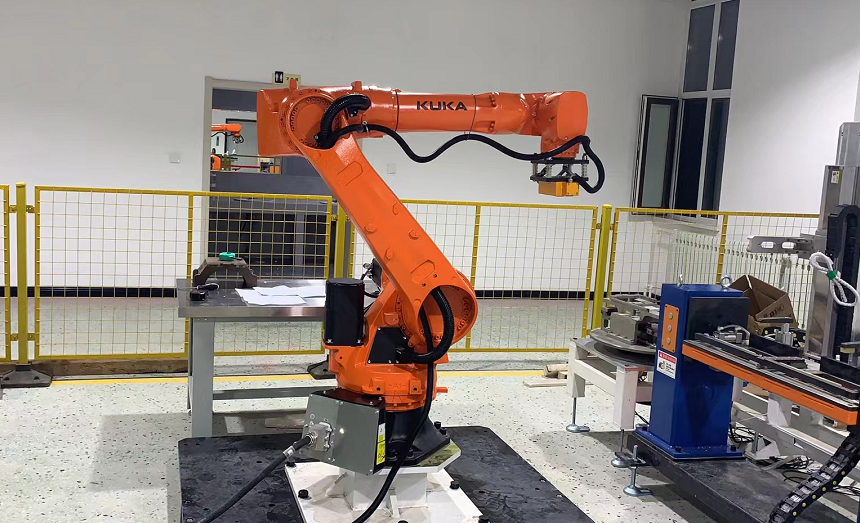
▲ automatic loading and unloading by KUKA robot
2. Description of the control principle
The inspection equipment uses a Keyence KV-8000 PLC as the EtherCAT Master to control a servo drive that moves the Keyence 3D profile scanner back and forth and up and down. The peripheral digital signals, such as the product detection photoelectric signal, the upper and lower limits and home signal of the servo, and the peripheral pushbutton and indicator signals, are acquired via the Solidot EtherCAT protocol Slice I/O modules XB6-EC2002ST, XB6-3200A and XB6-0032A.
The PLC communicates with the KUKA robot via the EtherNet/IP protocol to exchange the robot's material pick request and material place request signals. The Keyence 3D profile scanner communicates with the industrial PC via the TCP/IP protocol, and the PLC also communicates with the host computer via this protocol. After receiving the scan signal sent by the PLC, the host computer controls and drives the 3D profile scanner to scan via commands, and then the data scanned by the 3D profile scanner is fed back to the industrial PC in real time. Image data processing is then carried out, and a point cloud map is generated after the measured data of the actual product is obtained.
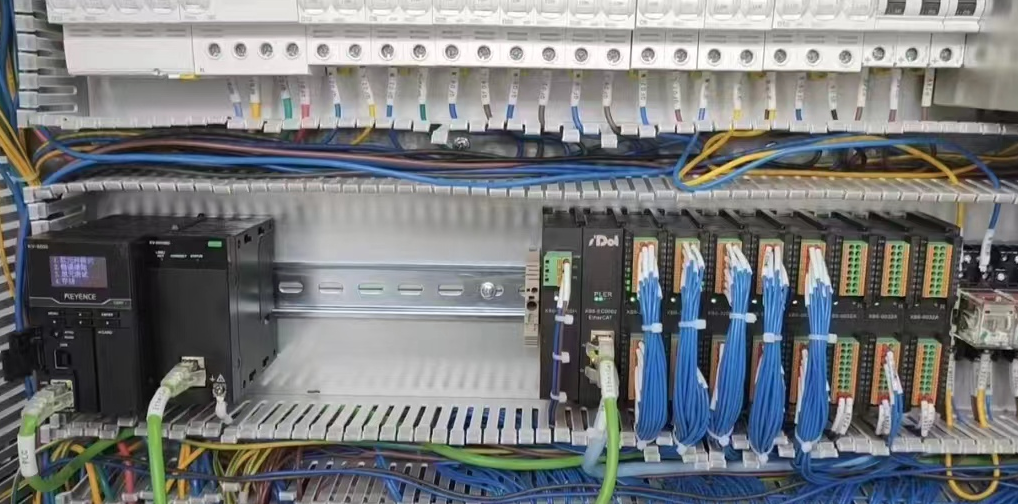
▲ Slice XB6-EC2002ST
3. Configuration in the Keyence KV STUDIO programming software and system block diagram
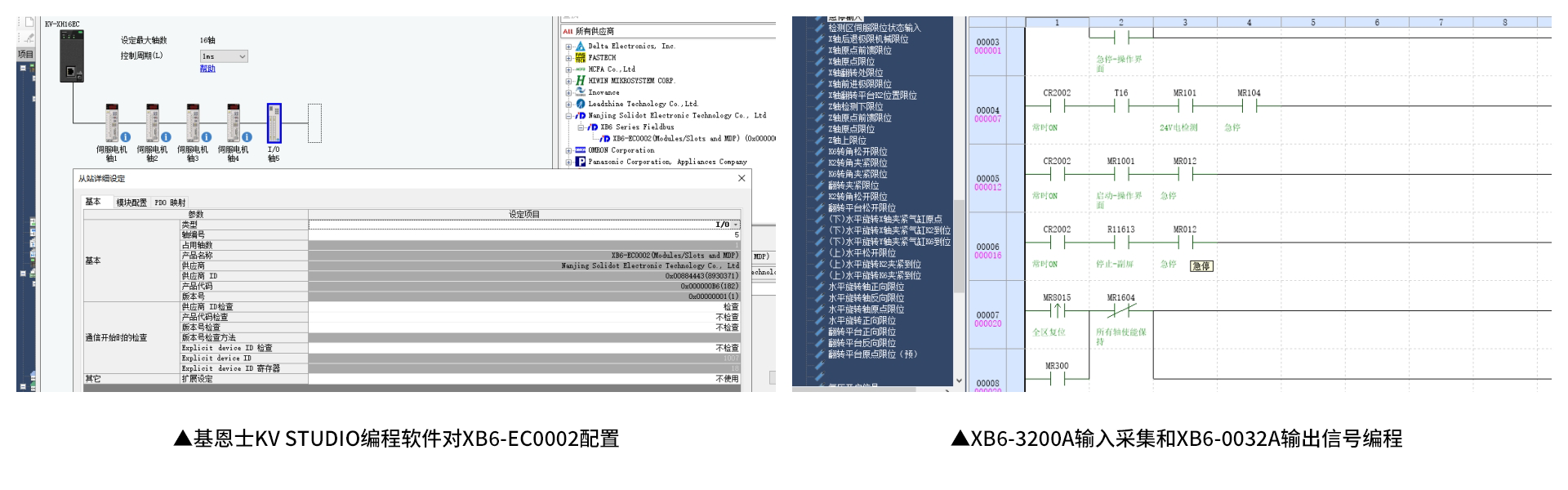
In the system, the Keyence KV-8000 PLC itself has a built-in network interface that integrates TCP/IP and EtherNet/IP protocols, while EtherCAT protocol motion control and remote I/O are implemented via the KV-XH16EC module.
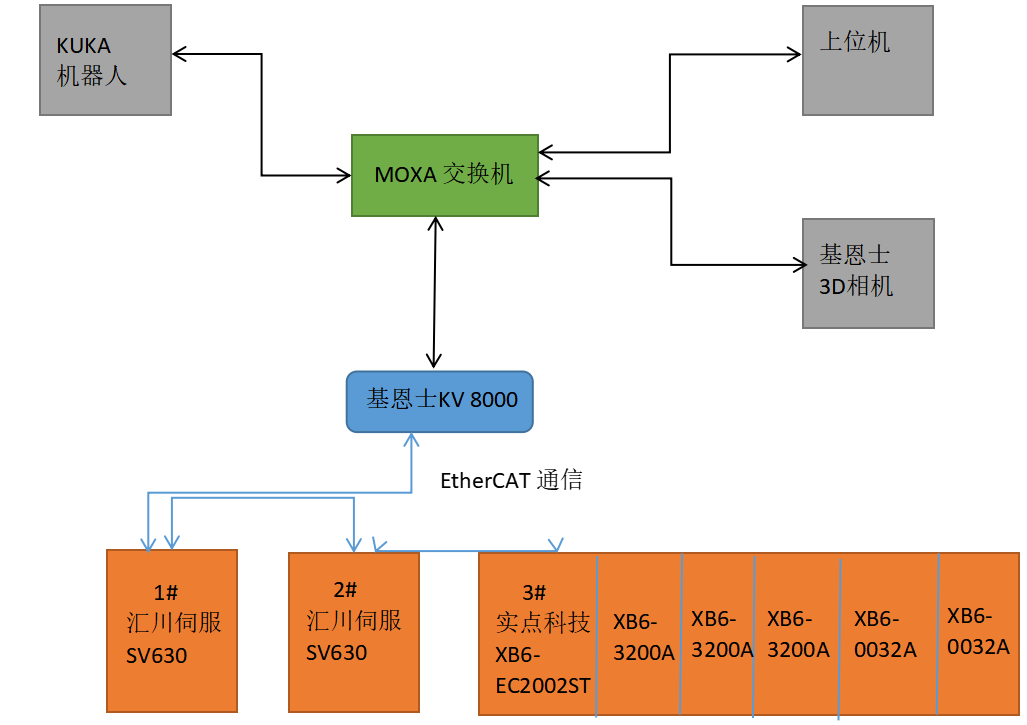
▲ system block diagram
Solidot EC4 and XB6 Series product introduction
Solidot integrated I/O module EC4-1616A and Slice I/O modules XB6-EC2002ST, XB6-3200A, and XB6-0032A all deliver outstanding performance in the above two cases. They are also representative products of the EC4 Series and XB6 Series, and are widely used across various industries.
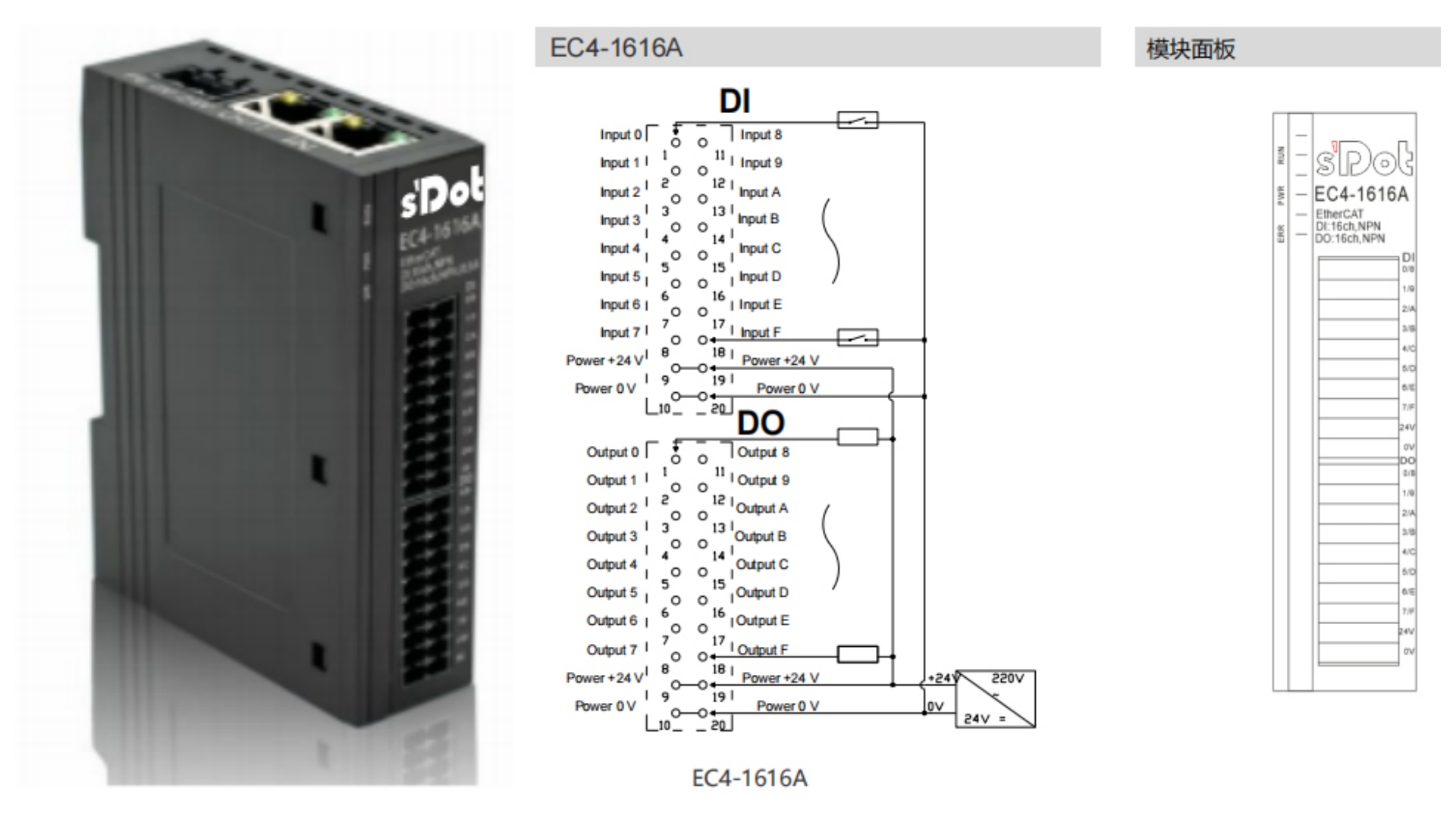
▲ integrated EC4-1616A
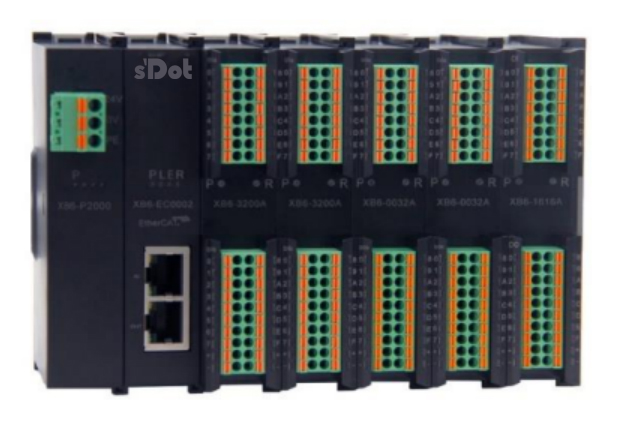
▲ Slice XB6-EC2002ST
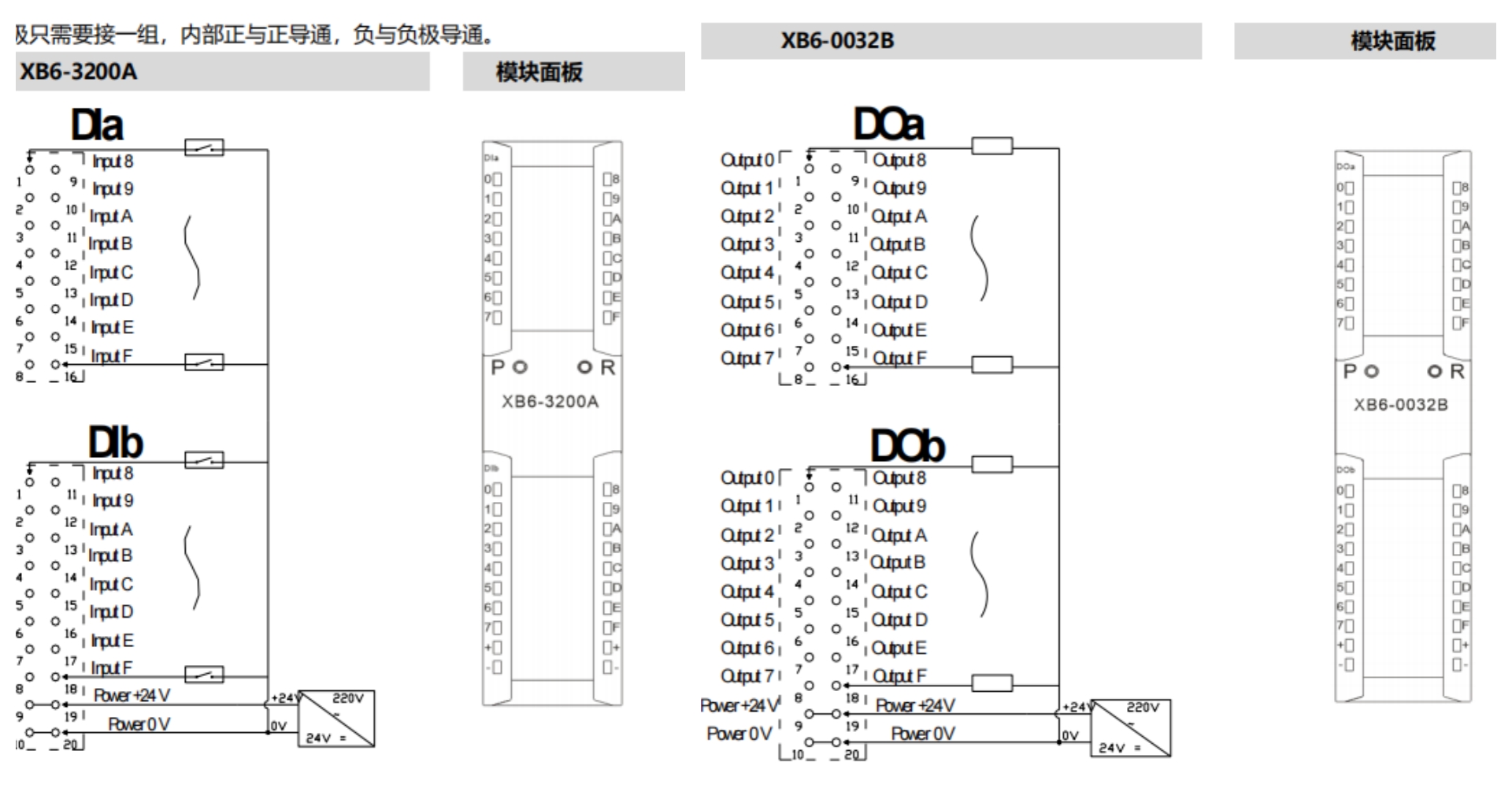
▲ wiring diagram of XB6-3200A and XB6-0032A
The Solidot EC4 Series integrated I/O module is based on the EtherCAT Industrial Ethernet Fieldbus. With a compact product structure and small footprint of only 102 x 72 x 25 mm, it is the flexible champion in configuration. The XB6 Series Slice I/O module features a scientific and practical design structure combining a Coupler and I/O modules. Its Communication Backplane uses the X-bus, with a maximum scan cycle of 1 ms, making it a versatile performer with both extensibility and Transmission rate.
Whether integrated or Slice, Solidot's I/O modules offer advantages such as high real-time performance, a rich variety of module types, and easy configuration and diagnostics. They provide customers with a wide range of choices and solid assurance for high-speed data acquisition, optimized system configuration, simplified field wiring, and improved system reliability, continuing to write one after another word-of-mouth case of "professionalism creates value" across various industries.
Recommended Products

EC4-1616A
EtherCAT, Integrated I/O, 16DI, 16DO, NPN, 0.5A

XB6-3200A
32 DI, NPN, European style terminal

XB6-0032A
32 DO, NPN, 0.5A, European style terminal

XB6-EC2002ST
EtherCAT coupler kit:inclue EtherCAT coupler(XB6-EC0002)、2A power supply(XB6-P2000H)、end cover( XB6-CVR00)