Knowledge

The photovoltaic cell production line places high demands on cleanliness and pick-and-place reliability in the incoming material handling stage. Cells are brittle and easily damaged, so in-position detection, distance feedback and appearance recognition during unpacking and pick-and-place directly affect the quality and cycle stability of downstream processes. Distributed I/O modules, valve terminals and industrial switches are becoming the mainstream choice for automation control in such equipment. This case study takes cell unpacking and loading equipment as its subject and demonstrates the combined application of Solidot XB6S Series Slice I/O, C3 Series Valve terminals and SW4 Series Industrial Switches.
Solidot products used in this case study
XB6S Series Slice I/O
C3 Series Valve terminal
SW4 Series Industrial Switch
Equipment overview
The cell unpacking and loading equipment is used for unpacking and automatic loading of incoming photovoltaic cells, and consists of an unpacking station, a cover plate removal station and a magazine conveyor unit. Cells are delivered in full boxes; the equipment sequentially performs box positioning, box opening and cover removal, packaging material removal and piece-by-piece pickup, then places the cells into magazines for transfer to the next process. The main work sequence is as follows:
Process step | Action description |
① Incoming material in position | The cell packaging box is transported by AGV to the unpacking station and positioned |
② Unpacking and cover removal | The pneumatic gripper actuates and removes the box cover |
③ Packaging removal | The gripper removes the inner packaging material, exposing the cells |
④ Cell removal and inspection | Cells are removed one by one and, after visual inspection confirms they are undamaged, placed into the magazine |
⑤ Transfer to welding | The magazine filled with cells is transported to the downstream welding process |
Solidot solution
Automation control in the unpacking and loading stage involves multiple types of signals and actions: digital signals such as box in-position and gripper position, distance measurement signals related to pick-and-place distance, and visual recognition of cell appearance; pneumatic grippers must also be driven to perform multiple pick-and-place actions. The control points are distributed across the unpacking and cover plate removal stations, and the signal types cover digital input, analog input and pneumatic output, placing high demands on the coordination of acquisition, drive and data exchange. Cells are brittle and easily damaged, so pick-and-place actions require in-position and distance feedback to ensure accurate execution, and damage risks must be identified immediately during cell pickup to prevent them from reaching downstream processes.
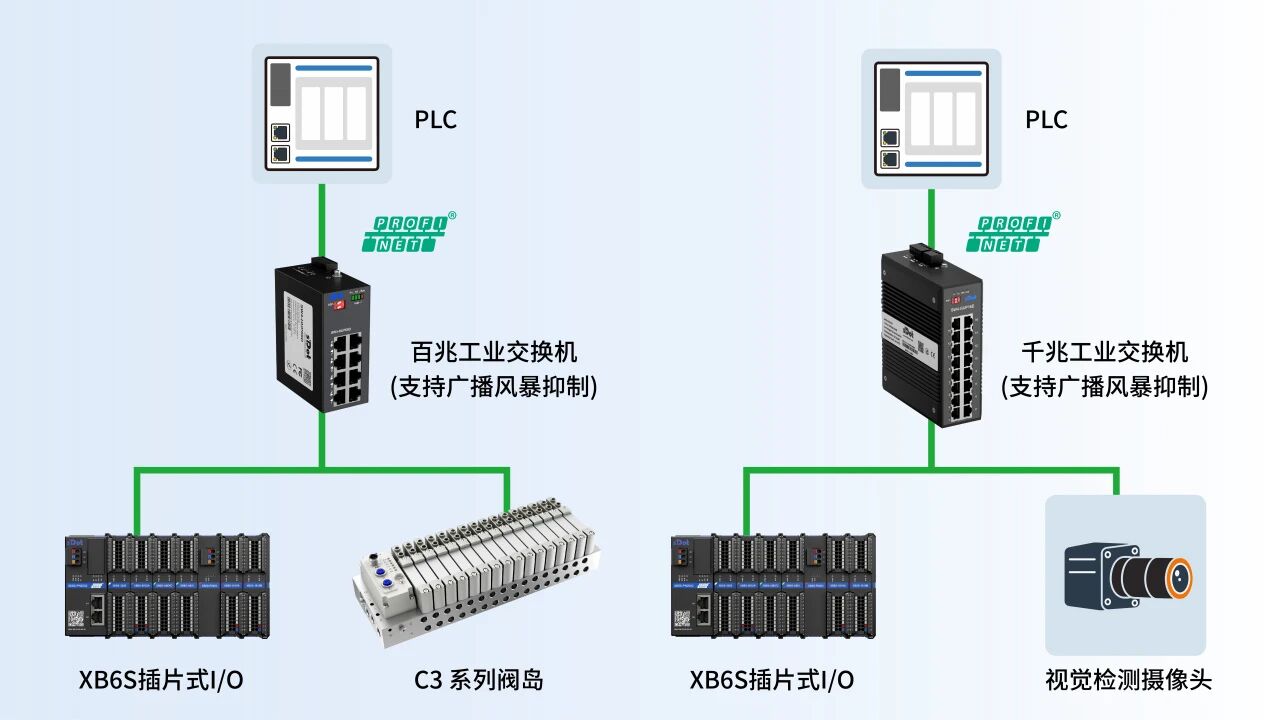
This solution combines XB6S Series Slice I/O, C3 Series Valve terminals and SW4 Series Industrial Switches: digital in-position signals and analog distance measurement signals are acquired nearby via XB6S Series Slice I/O, pneumatic actions are driven nearby by C3 Series Valve terminals, and camera images are forwarded via SW4 Series Industrial Switches to the industrial PC for damage detection; the vision results are merged with control data into the Siemens S7-1500 PLC for unified scheduling, so that acquisition, recognition and execution are coordinated within the unpacking stage.
System architecture
Control layer:
The Siemens S7-1500 PLC serves as the core controller, responsible for logic scheduling and cycle coordination of the unpacking and loading process; the industrial PC runs the vision program to perform cell damage recognition.
Network layer:
XB6S Series Slice I/O and C3 Series Valve terminals connect to the PLC via PROFINET; SW4 Series Industrial Switches (SW4-GUP16D, SW4-HUP08D) serve as network aggregation nodes, carrying data exchange between the PLC, remote I/O stations, cameras and the industrial PC.
Field layer:
The unpacking station uses the PROFINET coupler XB6S-PN2002 with the digital input module XB6S-1600 and the digital output module XB6S-0016B: the input module captures the in-position signal of the packaging box, and the output module drives solenoid valves to control the positioning cylinders, clamping and releasing the box; the analog module XB6S-A80ID is connected to a laser distance sensor to provide distance feedback for the pick-and-place motions; the cover removal station uses the C3 Series Valve terminal to drive pneumatic grippers, performing pneumatic actions such as opening the box and removing the cover, removing the packaging, and picking and placing the cells.
Application results
Dimension | Application performance |
Motion coordination | In-position detection, pneumatic pick-and-place and damage identification are smoothly interlinked, ensuring stable operation of the unpacking and loading process |
Signal coverage | Digital signals, analog signals and vision signals are acquired and aggregated via distributed nodes, reducing long-distance signal wiring |
Flexible deployment | I/O and valve terminals are arranged locally by workstation, control nodes are adjusted as the equipment layout changes, and maintenance troubleshooting is straightforward |
Solidot I/O products
[XB6S Series Slice I/O] Compatible with multiple bus protocols, with function modules for motion control and serial communication; the products have passed stringent EMC testing, offer strong interference immunity, and resist disconnection; they support diagnostics, alarms and exception log recording, providing intelligent feedback and convenient use.
[C3 Series Valve terminal] Supports configurations of up to 24 double solenoid valves, protection rating IP65; in-house developed solenoid valves with low-power design, supporting online firmware upgrades. Air nozzle specifications and valve slice types can be flexibly configured according to on-site process requirements.
[SW4 Series industrial switch] Covers unmanaged and managed types, with port densities of 5, 8 and 16 ports, and optional POE power supply and SFP Fiber port versions, adapting to the vast majority of industrial Ethernet networking scenarios.