Knowledge


In lithium battery production, material trays handle the transfer of cells and modules, and their placement state determines whether subsequent pick-and-place actions can be carried out smoothly. This case study takes lithium battery tray handling equipment as its object and demonstrates the application of Solidot IO-Link series products in tray placement detection.
Solidot products used in this case study
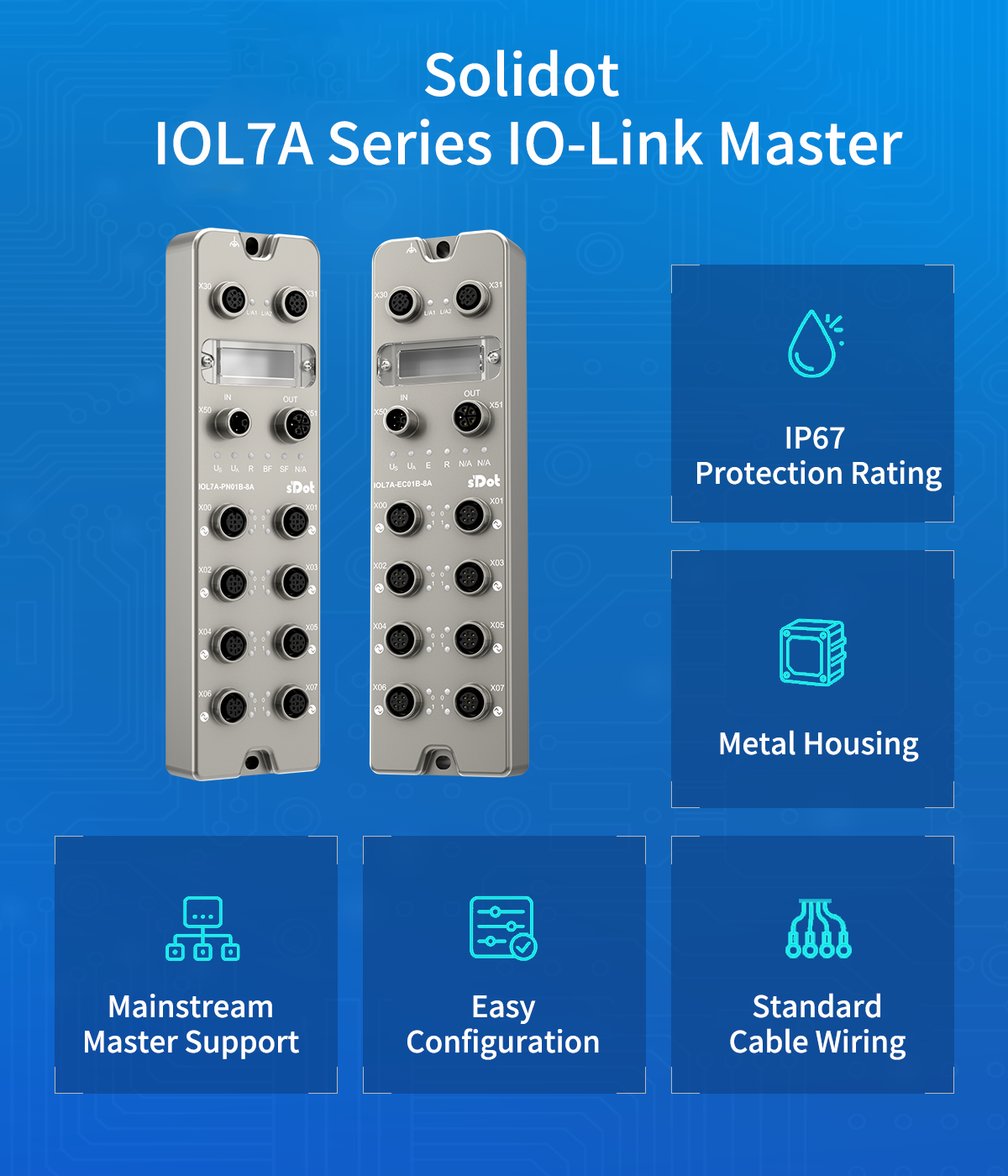
(EtherCAT protocol IO-Link Master, 8-channel class-A interface, IP67)
Equipment introduction
Lithium battery tray handling equipment is used for the transfer and placement of trays between process steps. It consists of a conveying unit, a handling mechanism and a placement station. The handling mechanism picks up and places the trays, and the placement station provides the positioning reference for the trays. The main operating sequence is as follows:
Process step | Action description |
① Tray loading | The tray is conveyed to the pick-up position by the conveyor unit |
② Tray gripping | The handling mechanism picks the tray from the pick-up position |
③ Tray transfer | The tray moves along the defined path to the target station |
④ Tray placement | The tray is lowered onto the placement station and positioned |
⑤ Placement verification | Verify the placement status of the tray at the station |
Solidot solution
After a tray is placed in the station, whether it is fully seated and whether it is placed flat is reflected as the height difference between the tray reference surface and the datum. If point switches are used for the judgment, each judgment position requires a detection point and only a present/absent result can be given, making it difficult to distinguish states such as a tilted tray or one that is not fully seated; if an analog output is used, an analog input channel must be occupied and shielded wiring laid separately, and information beyond the distance value cannot be acquired at the same time; when the measured value is transmitted digitally, the continuous distance value and the sensor operating status can be read together.
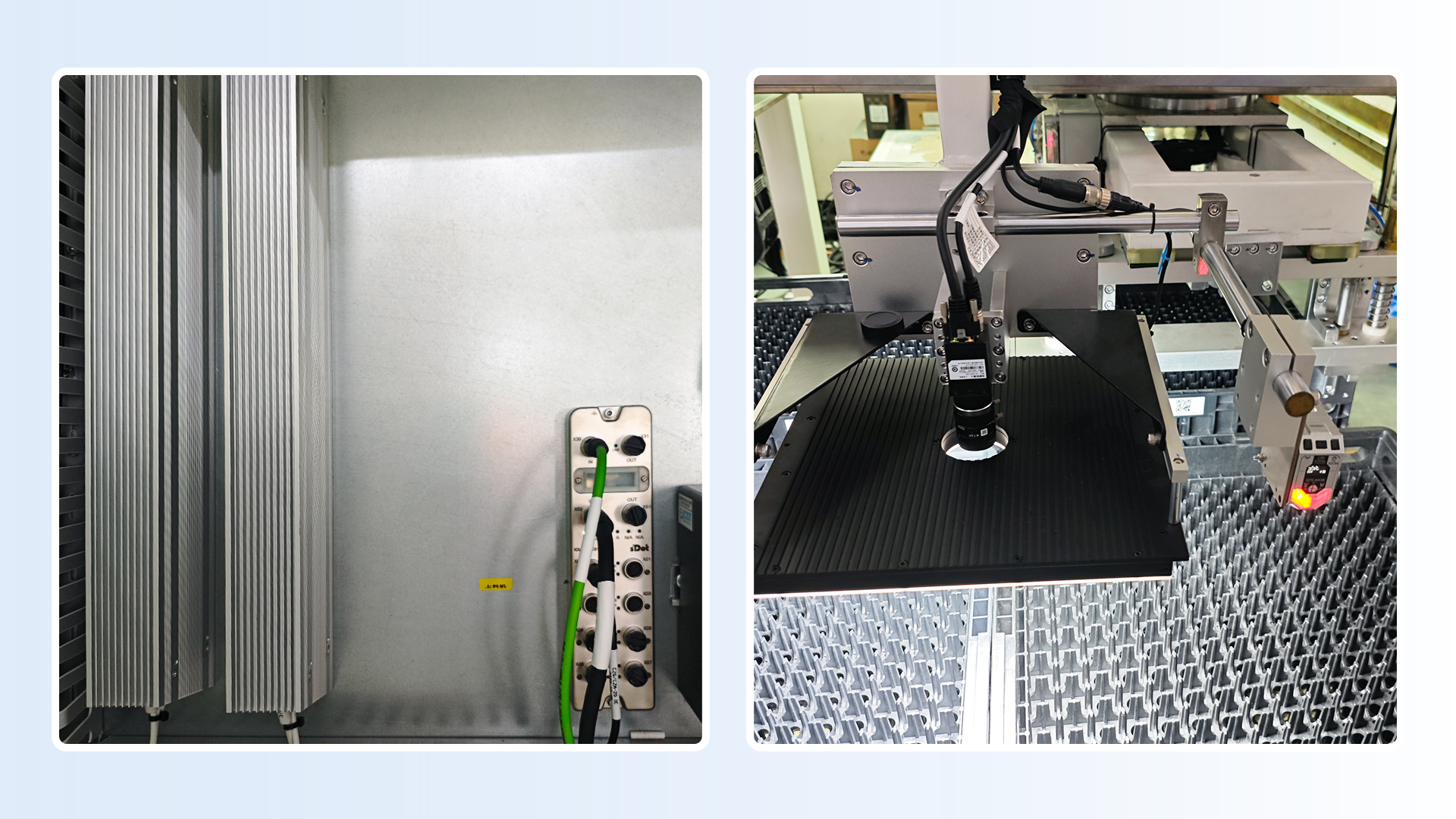
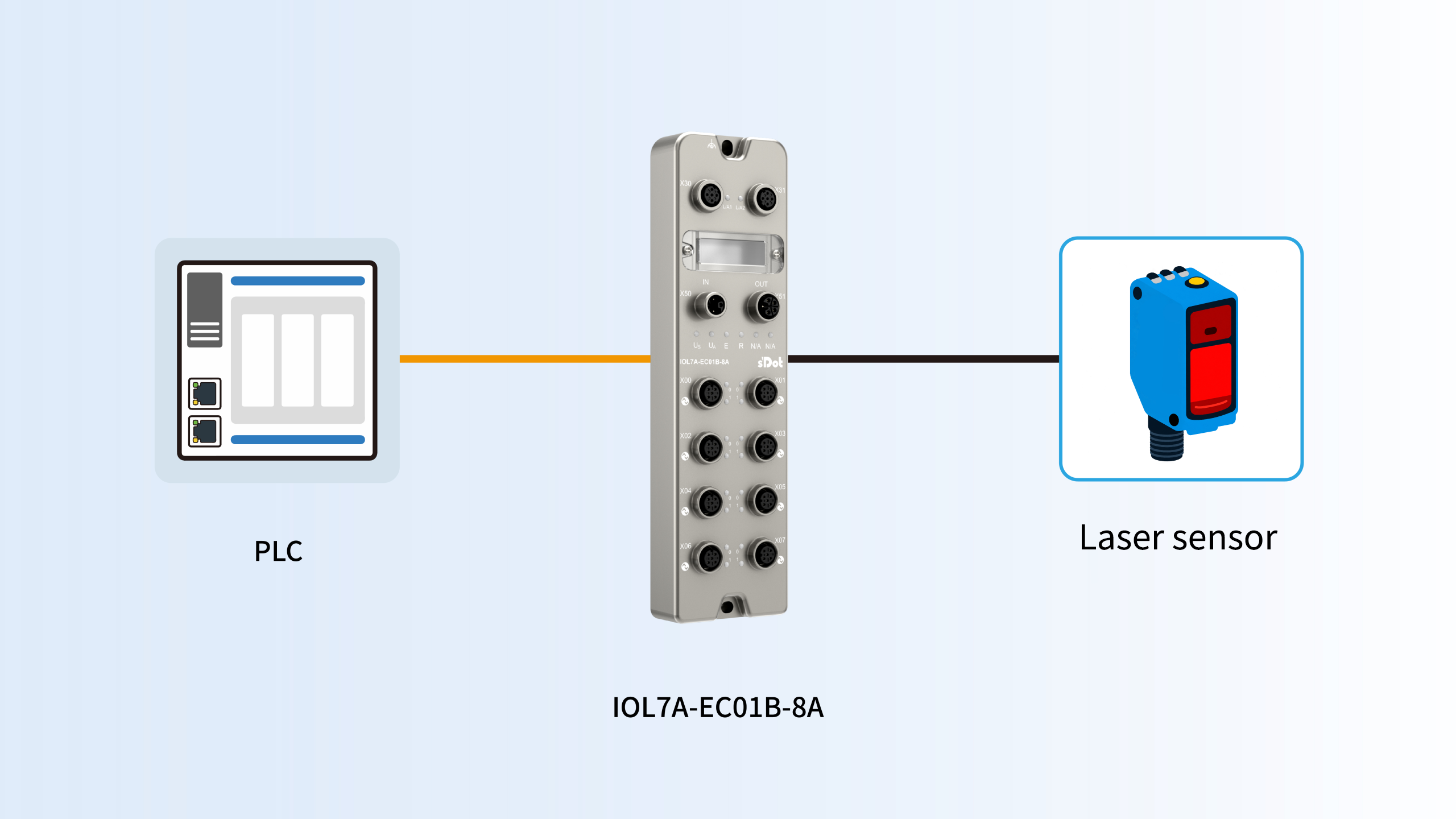
The solution uses the Solidot IOL7A-EC01B-8A as the IO-Link Master; the measuring sensors must support the IO-Link protocol.
Solution architecture
Control layer:
The Inovance AM523 PLC serves as the controller and is responsible for motion control of the handling mechanism and for determining the tray placement state.
Network layer:
The network port of the Solidot IOL7A-EC01B-8A master is connected to the Inovance AM523 PLC via EtherCAT.
Field layer:
Omron E3AS-HF series TOF laser sensors are arranged at the placement station, with the detection direction facing the tray reference surface, and are connected to the IO-Link port of the master via M12 connectors; the sensors acquire the distance to the tray reference surface, and the master consolidates the process data.
Application results
Dimension | Application performance |
Detection method | Placement status is determined from a continuous distance value; a single detection point covers the tray's placement height range |
Readable status | Process data such as received light intensity can be read, allowing declining detection capability to be detected early |
Maintenance convenience | The measurement parameters are downloaded via the master, so sensors can be replaced without reconfiguration. |
V. Solidot IO-Link Series Products
The Solidot IOL7A-EC01B-8A is an IO-Link Master with IP67 protection rating. The bus side supports EtherCAT, and the user side provides 8 IO-Link class-A ports. It supports slave parameter backup and automatic recovery, and the port and channel status is indicated by indicators for easy on-site diagnostics. The operating temperature is -25 ... +70 °C, making it suitable for scenarios such as lithium battery production that place high demands on on-site protection.