Knowledge

In the precision handling stage of a TFT-LCD production line at a liquid crystal panel manufacturer, the robot and the PLC often belong to different bus protocol systems. The data mapping and real-time performance between the two systems directly affect the line's coordination accuracy and operational stability. This case study takes this production line as its subject and demonstrates the application of Solidot slave protocol conversion gateway modules in heterogeneous protocol interconnection.
Solidot products used in this case study
(Slice gateway EtherCAT Slave to CC-Link slave kit)

Device introduction
The precision handling stage of this production line is performed jointly by an industrial robot and a PLC control system, which handle the picking, placing, positioning and transfer of glass substrates. The robot side must provide real-time feedback on end effector position, motion speed and gripper status, while the PLC side handles the line's logic control, issuing motion commands to the robot and receiving status signals. The coordinated response of the two directly affects handling accuracy and line cycle time.
Stage | Action description |
Pick-and-place and transfer | The robot grips the glass substrate and completes transfer and positioning between stations |
Status feedback | The robot provides real-time feedback on end effector position, motion speed and gripper status |
Command issuing | The PLC issues motion commands to the robot, such as substrate gripping and station switching |
Status reception | The PLC receives robot status signals for line cycle coordination and logic decisions |
Solidot solution
The conversion stage between heterogeneous bus protocols places high demands on the completeness of data mapping and forwarding latency: data such as the robot's joint coordinates, gripper pressure and fault codes must be accurately mapped to the PLC register area, and motion commands issued by the PLC must also be forwarded to the robot in a timely manner. The coordinated response of the two directly affects the positioning accuracy and motion cycle time of substrate handling.
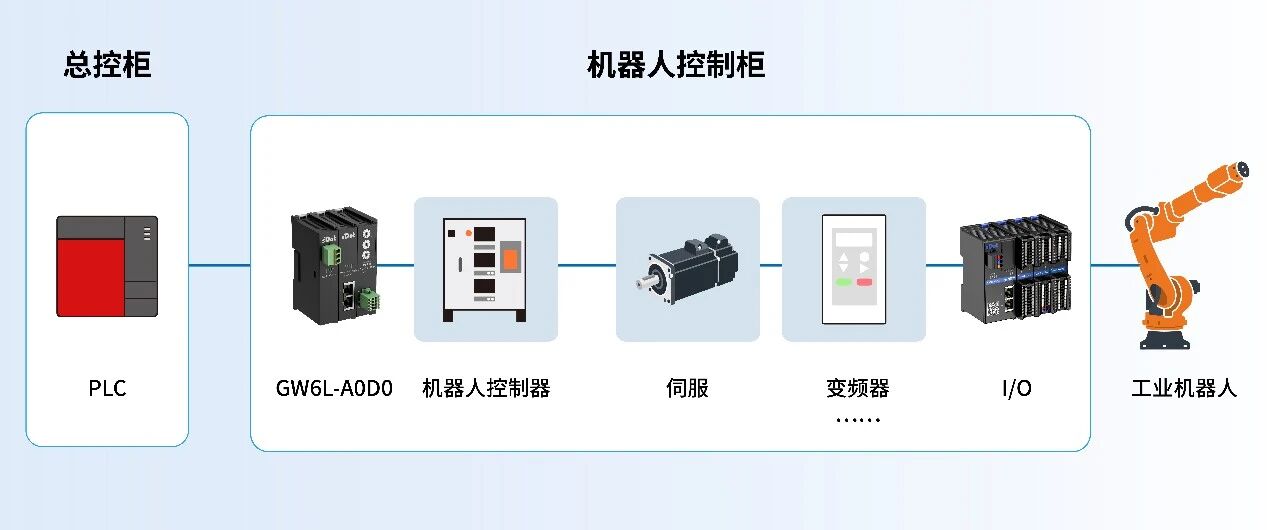
This solution connects the Solidot GW6L-A0D0 to the EtherCAT port of the KUKA robot controller via its EtherCAT interface to acquire data such as the robot's joint coordinates, gripper pressure values and fault codes; at the same time, it connects to the PLC via its CC-Link interface, enabling bidirectional data bridging between the two protocol systems.

Solution architecture
Control layer:
The Mitsubishi Q series PLC serves as the core controller, responsible for production line logic scheduling, issuing motion commands to the robot and receiving status feedback.
Network layer:
The GW6L-A0D0 gateway connects to the KUKA robot control unit via the EtherCAT interface and to the PLC master via the CC-Link interface, implementing bridge conversion between the EtherCAT and CC-Link protocols.
Field execution layer:
Data such as joint coordinates, gripper pressure and fault codes collected by the robot is mapped through the gateway to the RWr (remote read register) area of the PLC, and the PLC's motion commands are sent via the RWw (remote write register) area, with a clear data mapping path and bidirectional flow.
Connected device | Protocol characteristics | Gateway adaptation solution |
KUKA KR AGILUS | EtherCAT master | Built-in ESC chip, Supports APWR/APWRW instructions |
Mitsubishi Q series PLC | CC-Link V2 master, 10 Mbps rate | Compatible with the QJ61BT11 module, Supports automatic refresh |
Application results
Dimension | Application performance |
Protocol interoperability | The EtherCAT and CC-Link protocols are converted bidirectionally in the gateway itself, Data exchange between the robot and the PLC requires no additional intermediate gateway |
Data Mapping | Various types of data such as joint coordinates, gripper pressure and fault codes can be mapped to designated register areas of the PLC, with a clear path for command issuing and status feedback |
Environmental adaptability | Wide-temperature design and interference immunity testing, suitable for continuous operation in cleanrooms and high-frequency electromagnetic environments |
Solidot slave protocol conversion gateway module
The Solidot slave protocol conversion gateway module uses a slice kit design and currently supports bidirectional conversion between five slave protocols: EtherCAT, PROFINET, Modbus TCP, CC-Link and EtherNet/IP. It uses high-speed backplane transmission, achieves a protocol conversion delay of less than 1 ms, and has an operating temperature range of -40 °C ... +70 °C, making it suitable for industrial scenarios with high requirements for protocol conversion real-time performance and environmental adaptability, such as cleanrooms and high-frequency electromagnetic environments.