Knowledge


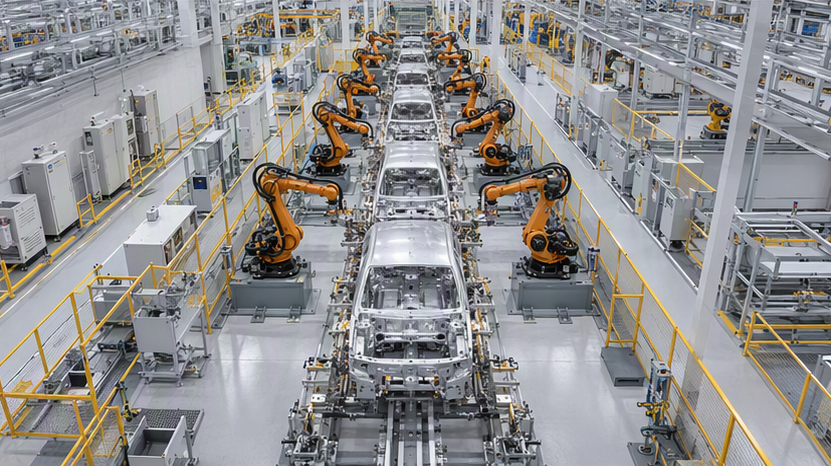
Body-in-white welding equipment is a core asset in automotive body manufacturing. Fixture signal points are numerous and distributed, while welding spatter and dust act directly on field devices, making the I/O deployment method a key factor affecting on-site layout and long-term operation. This case study focuses on body-in-white welding equipment to demonstrate the application of Solidot's IO-Link series products.
Solidot products used in this case study
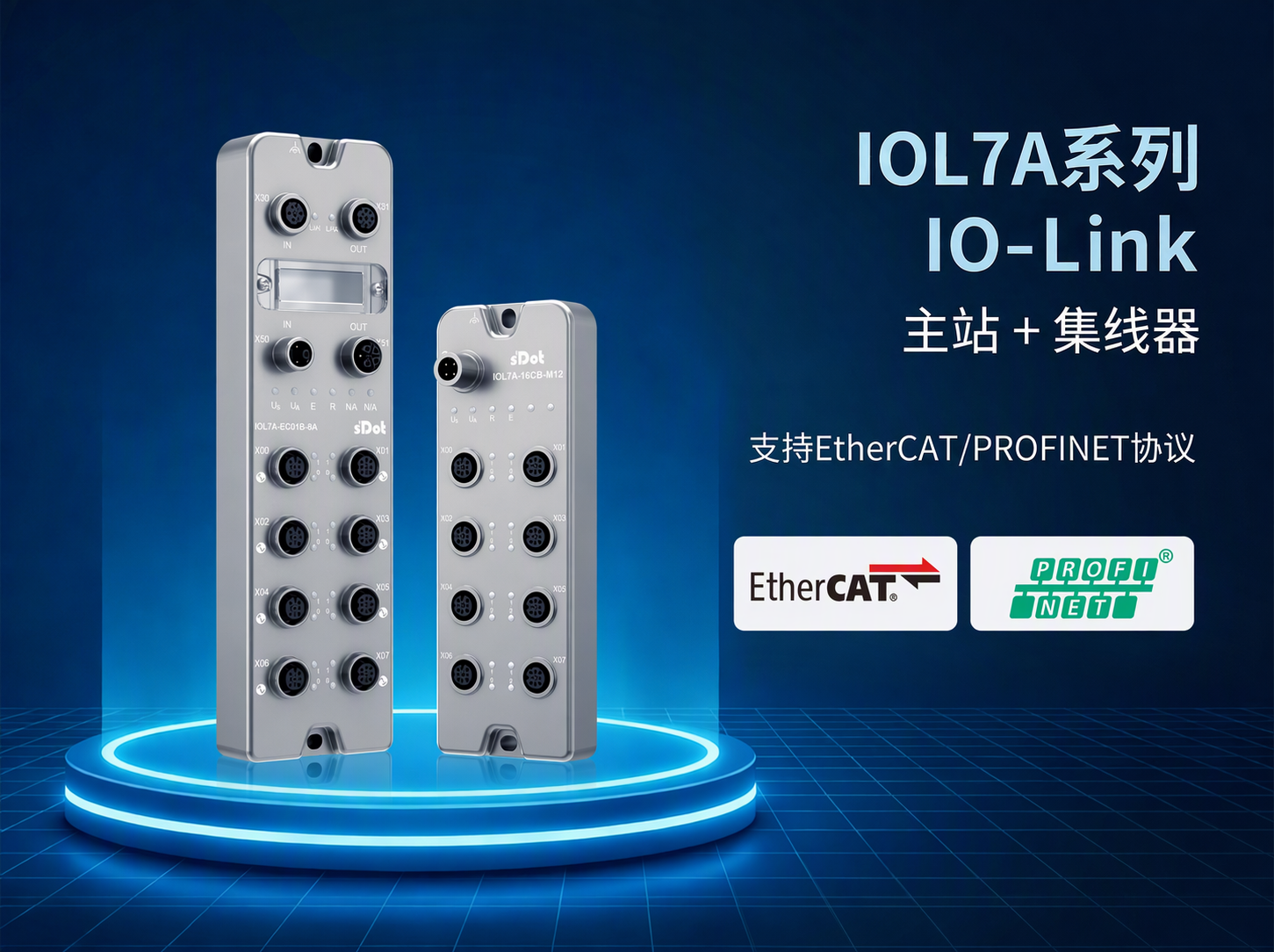
(PROFINET protocol IO-Link Master, 8*class-A ports, IP67)
(IO-Link Hub, 16-channel digital input, PNP, IP67)
(IO-Link Hub, 16-channel digital output, PNP, IP67)
(IO-Link Hub, 16-channel configurable input/output, PNP, IP67)
Equipment overview
Body-in-white welding equipment is used for welding and forming body-in-white components and consists of multiple welding robots, welding fixtures and conveying units. The main process flow is as follows:
Step | Action description |
① Component loading | Body-in-white components enter the station by conveyor or hoist and are initially positioned |
② Clamping and positioning | The fixture cylinder actuates to secure the component in the welding position |
③ Robot welding | The welding robot aligns to the weld spot positions and completes the spot welding operation |
④ status monitoring | Monitors the fixture clamping In-position status and welding completion status |
⑤ Release and transfer | The fixture releases and the component is transferred to the next station |
Solidot solution
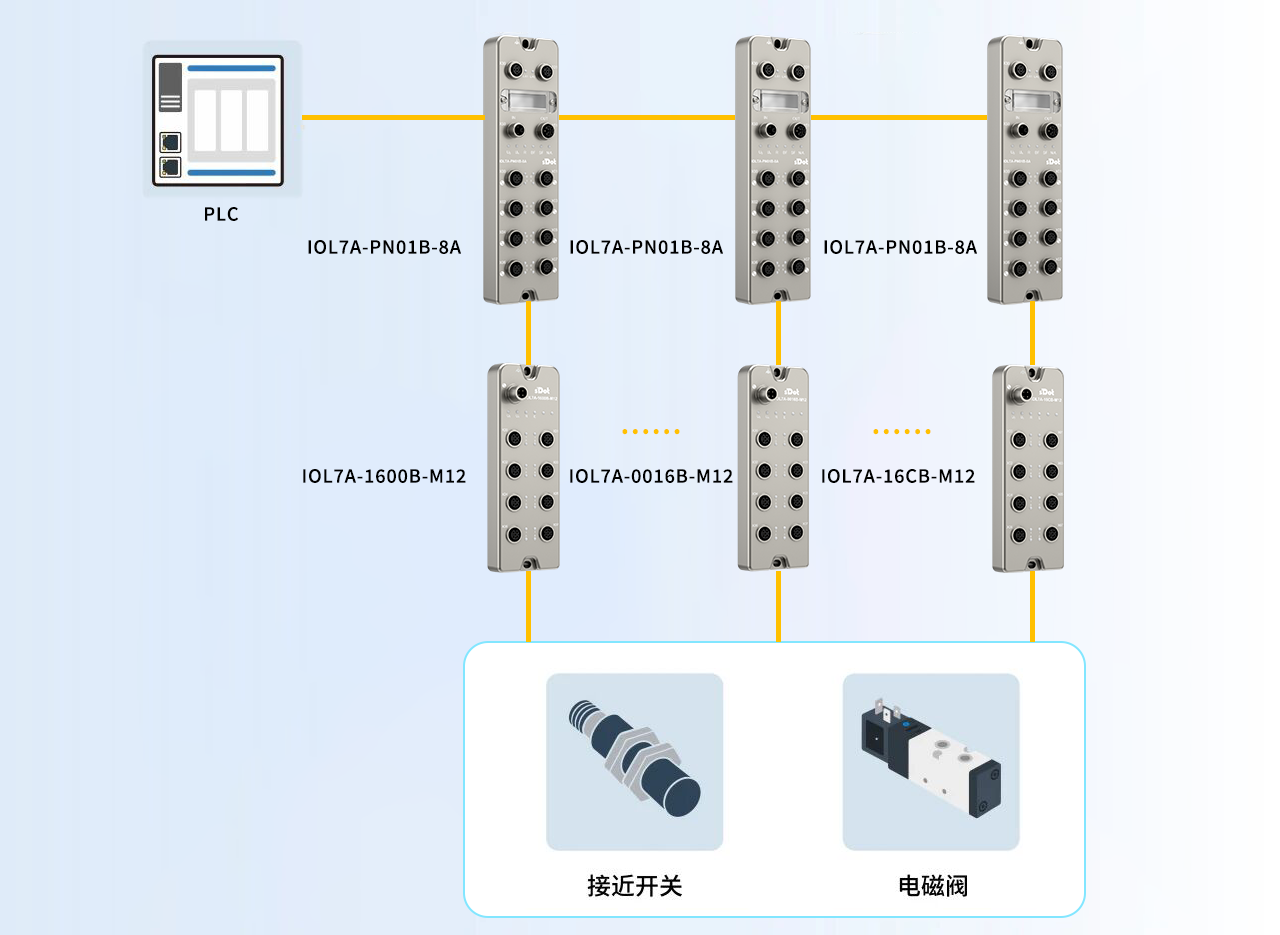
The line has a large number of welding fixtures. Routing all these signals centrally to a single control cabinet would increase on-site wiring, and the cables would have to cross the robot working area, adding to the burden of installation and troubleshooting. The solution uses Solidot IO-Link Masters and slaves to form distributed I/O units; both masters and slaves have an IP67 protection rating.

Solution architecture
Control layer:
A Siemens S7-1500 PLC serves as the core controller and is responsible for scheduling the sequence of welding robot and fixture actions.
Network layer:
The IO-Link Master connects to the PLC via PROFINET, and a single bus supports multi-station deployment; the master and slaves are connected with standard cables, resulting in a clear network structure.
Field layer:
A total of more than 100 IO-Link Masters and more than 400 slaves are deployed on this production line; the masters and slaves are installed below the welding robot pedestals and inside the PVC baffles. Each master is connected to 6 ... 8 slaves, some of which are reserved for redundancy and are temporarily not wired; the input channels of the slaves acquire the In-position signal of the fixtures, and the output channels drive the Solenoid valve of the clamping cylinders.
IV. Application results
Dimension | Application performance |
Wiring optimization | The number of long-distance Drop lines is reduced, lowering assembly and wiring-check workload; the length of cabling exposed in the welding area is correspondingly shortened |
On-site adaptability | The IP67 protection rating protects against spatter and dust |
Easy maintenance | Supports remote parameter configuration and status diagnostics; plug-in connections facilitate replacement |
V. Solidot IO-Link series products
Solidot IO-Link IOL7A series products can be adapted to bus protocol such as EtherCAT and PROFINET. They feature a metal housing and an IP67 protection rating, and offer pluggable connections, diagnostic options, Shock resistance and vibration resistance. They are widely used in industrial scenarios such as automotive manufacturing and logistics, enabling fast device connection, efficient data transmission and intelligent system management.