Knowledge

The lithium battery pack production line is a key stage in the assembly of power batteries from cells to packs, involving multiple processes such as cell sorting, module stacking, welding, inspection and testing. Inspection points along the entire line are distributed, and digital and analog signals coexist, placing high demands on the signal connection capability and deployment flexibility of I/O modules. This case study takes a lithium battery pack production line as its subject and demonstrates the practical application of Solidot IO-Link bus I/O.
Solidot products used in this case study
(IO-Link Master, PROFINET protocol)
(IO-Link HUB, 16-channel configurable digital signal, PNP)
(IO-Link HUB, 8-channel voltage/current input/output compatible)
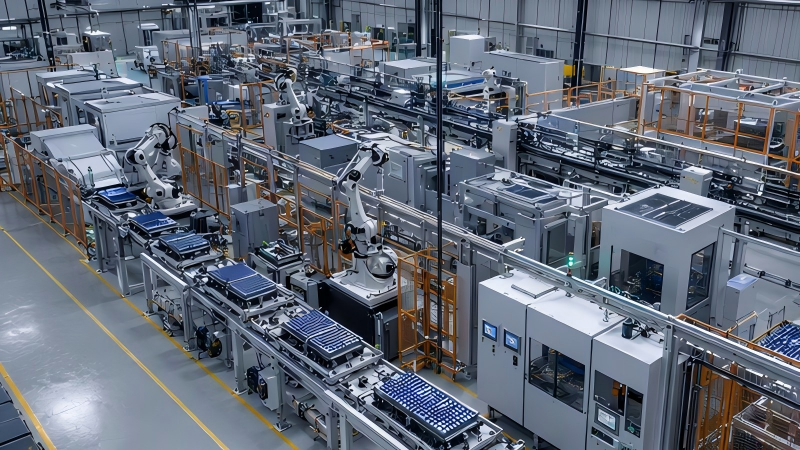
Device introduction
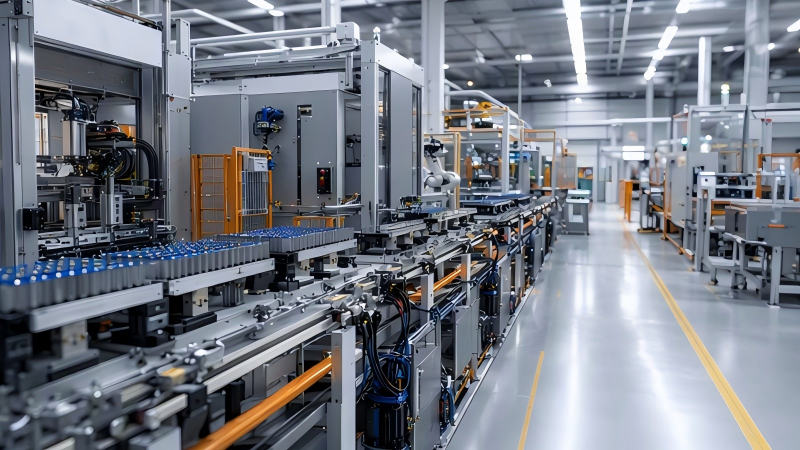
A lithium battery pack production line typically consists of a cell loading and sorting unit, a module stacking unit, a plasma cleaning unit, a tab welding unit, an inspection unit, and a testing and off-line unit, completing the full process from cell feeding and module assembly to welding and fixing and final pack inspection and acceptance.
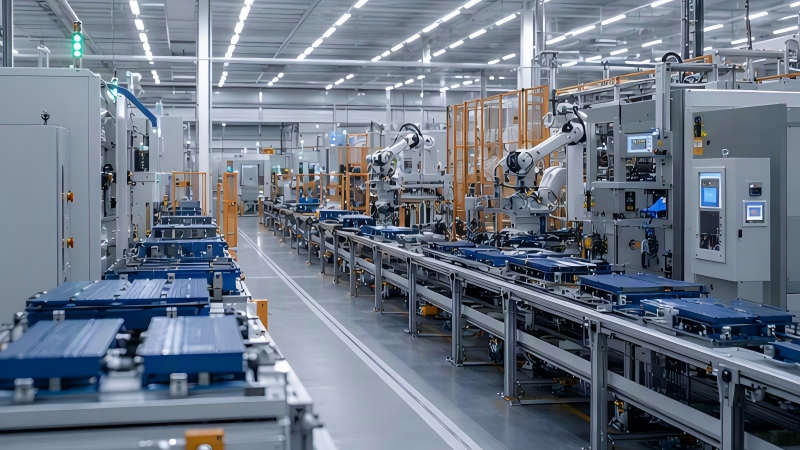
process | Action description |
① Cell loading and sorting | automatic cell loading, sorted by parameters such as capacity and internal resistance |
② module stacking | Cells are stacked into modules in series/parallel order, with positioning fixtures |
③ Plasma cleaning | Plasma cleaning of tab and busbar surfaces |
④ Tab welding | Laser welding of busbars and tabs to complete the electrical connection |
⑤ (5) Visual inspection | The vision system inspects the module appearance and assembly status, with airflow dust removal before inspection to keep the workpiece clean |
⑥ (6) Testing and off-line | Off-line after pack-level airtightness testing and charge/discharge testing |
II. Solidot solution
The inspection points on a lithium battery pack production line are distributed across multiple stations such as cell feeding, module stacking, welding, inspection and testing. Digital signals such as cylinder action feedback, material-in-position and safety guarding, as well as analog signals such as wind speed and distance measurement, must be connected at the same time. With diverse signal types and distributed points, high demands are placed on the signal connection capability and deployment flexibility of the I/O modules.
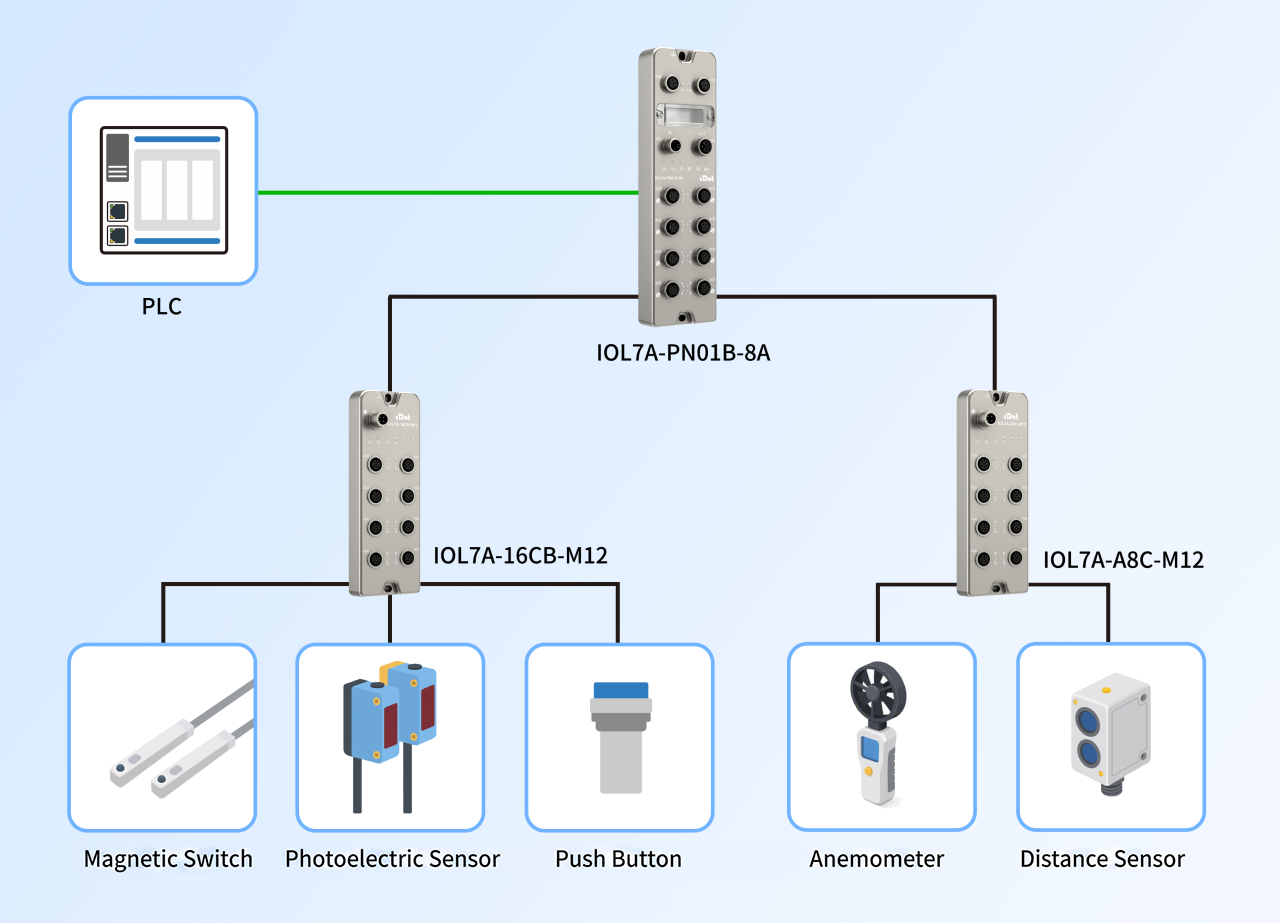
The solution adopts the Solidot IO-Link bus I/O architecture. Through the combination of an IO-Link Master and IO-Link HUBs, the digital and analog signals on site are connected to the same network. The modules use an IP67 metal housing and can be mounted directly close to the equipment. Three-wire sensors are connected directly via M12 connectors, meeting the control requirements of a pack line with distributed stations and diverse signals.
III. Solution architecture
Control layer:
The Siemens S7-1500 PLC serves as the core controller, responsible for logic scheduling of the entire line, inspection data processing and cycle-time coordination.
Network layer:
The IOL7A-PN01B-8A master is connected to the PLC via PROFINET, and the IOL7A-16CB-M12 and IOL7A-A8C-M12 are connected to the master as IO-Link slaves in a cascading deployment along the production line.
Field layer:
The IOL7A-16CB-M12 handles digital signal acquisition and output at each station, covering signals such as cylinder action feedback, cell and module in-position, pallet in-position, safety guarding and operator buttons, and outputs to drive pneumatic actuators; the IOL7A-A8C-M12 handles analog acquisition at stations such as visual inspection, plasma cleaning and stacking positioning, connecting anemometer and distance sensor signals.
IV. Application results
Aspect | Application performance |
Signal compatibility | Digital and analog signals are integrated into a unified IO-Link system, Digital signal acquisition and analog acquisition such as wind speed and distance measurement are integrated into a single network |
Flexible deployment | The module features an IP67 metal housing and can be installed directly near the equipment, with signals connected on site |
Maintenance efficiency | IO-Link channel-level diagnostics support precise localization of signal anomalies, and the metal housing withstands the lithium battery production environment |
Solidot IO-Link bus I/O
Solidot IO-Link bus I/O is currently available in two protection ratings, IP67 and IP20: the IP67 models are IOL7A (metal housing) and IOL7B (plastic housing); the IP20 model is IOL5, with an optional dust cover.
A variety of product forms are available for flexible selection according to on-site conditions. They are compatible with mainstream bus protocols such as EtherCAT and PROFINET and provide acquisition solutions for multiple signal types including digital and analog, making them widely used in demanding industrial scenarios such as lithium battery, 3C and automotive manufacturing.