Knowledge

Solidot industrial Ethernet switches cover unmanaged and Layer 2 managed models, with port densities of 5, 8 and 16 ports, optional PoE power supply and SFP Fiber port variants, making them suitable for the vast majority of industrial Ethernet networking scenarios.
The entire product series features an industrial-grade wide temperature range (-40 °C ... +80 °C) and a compact housing, and forwards Modbus TCP, EtherNet/IP and PROFINET real-time telegrams transparently with low latency, ensuring compatibility with mainstream industrial protocols; based on the Store-and-Forward Mechanism with Full-duplex/Half-duplex Auto-Negotiation, they deliver more reliable long-term operation.
No need to leaf through manuals for selection — simply confirm the following 5 questions one by one:
Quick decision guide
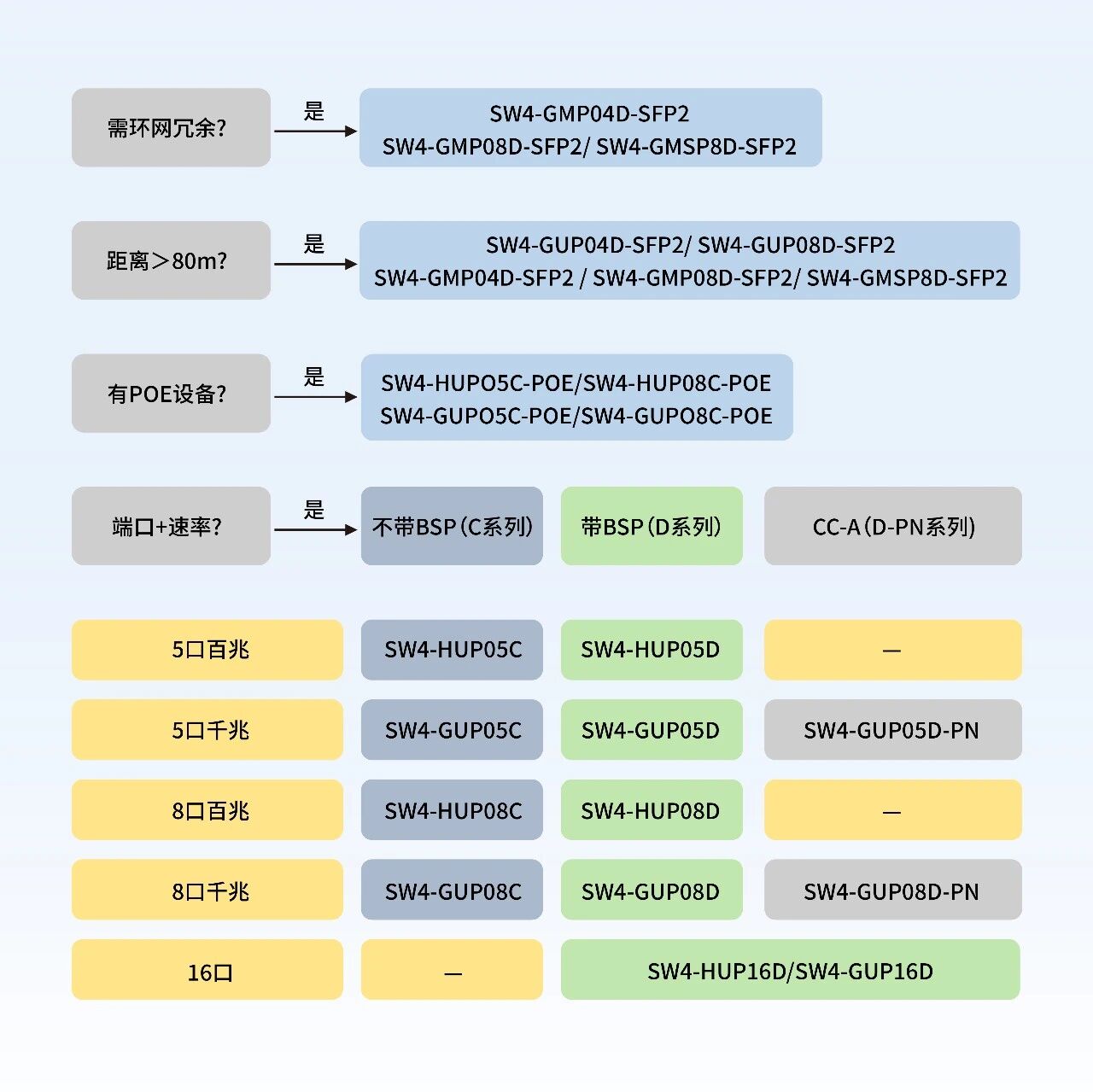
Note: For cross-protocol networking (e.g. PROFINET to Modbus TCP), a Solidot protocol gateway can be used.
1. Is Ring Redundancy required?
Unmanaged switches are Plug and Play and suited to star topologies; the key difference of managed switches lies in Ring Redundancy — when a backbone link fails, the backup path takes over automatically without interrupting operation. Solidot Layer 2 managed switches (GMP series) support STP/RSTP/ERPS ring protocols and also offer IGMP Snooping multicast filtering and SNMP V1/V2/V3 remote network management.
The criterion is simple: would the failure of one switch in the network disconnect all downstream devices? If yes, choose managed; if not, unmanaged is sufficient.
2. What is the installation environment?
The Operating temperature of ordinary commercial switches is generally 0 ... 40 °C, whereas the temperature inside a control cabinet can exceed 50 °C in summer. All Solidot products feature a wide temperature range (-40 °C ... +80 °C) and a compact design, handling harsh conditions with ease.
3. Is the Transmission distance greater than 80 m?
The nominal Transmission distance of a copper port is 100 m, which is a theoretical value under ideal conditions; electromagnetic interference at industrial sites shortens the effective distance. Beyond 80 m of actual cabling, signal attenuation and electromagnetic interference increase significantly, so fiber optic cable is recommended.
Requirement | Model | Ports |
Unmanaged + fiber ports | 4 copper + 2 SFP | |
Unmanaged + multiple copper ports + fiber ports | 8-port electrical + 2 SFP | |
managed + fiber ports | SW4-GMP series | 4-port electrical + 2 SFP or 8-port electrical + 2 SFP |
SFP fiber ports can be flexibly fitted with optical modules according to the actual distance, with no need to replace the switch.
4. Are there POE devices?
For terminals that require power, such as IP cameras, wireless APs and vision cameras, use a POE switch: a single Ethernet cable carries both data and power, saving wiring, power supplies and labor.
Ports | Fast Ethernet model | Gigabit model |
5-port | ||
8-port |
5. How do I determine the number of ports and the speed?
The first four options have already determined the type, fiber ports and POE; the last step is to determine the number of ports and Fast Ethernet/Gigabit.
Quantity: reserve 1.2—1.3 times the current number of devices. The cost of reserving one extra port is far lower than adding another switch later.
Speed: Fast Ethernet models (HUP) cover devices such as PLCs, frequency converters and HMIs (communication bandwidth approx. 10 Mbps); Gigabit models (GUP) are used for vision data transmission or upstream aggregation.
C/D difference: the D series adds Broadcast Storm Suppression. When there are more than 10 network devices or an uncontrollable broadcast source is present, the D series provides reliable protection for the network.
Ports | Fast Ethernet model C series | Fast Ethernet model D series | Gigabit model C series | Gigabit model D series |
5-port | ||||
8-port | ||||
16-port | — | — |
PROFINET-specific models SW4-GUP05D-PN and SW4-GUP08D-PN are also available. Based on the 5-port and 8-port Gigabit D series, they add PROFINET CC-A support — 802.1Q VLAN priority ensures that real-time RT frames are forwarded with priority and are not displaced by heavy TCP traffic. If PROFINET communication is the primary protocol on site, these models are the preferred choice.